Investing in Private Companies · GUIDE
Understanding Private Company Valuations
Educational overview of private-company valuation methods and their limitations. Private investments are speculative and illiquid and involve substantial risks, including risk of total loss. Past performance is not indicative of future results.
6 min read
Updated July 23rd, 2026
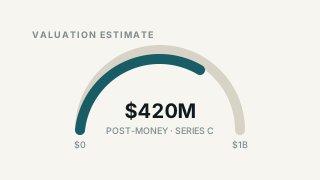
Valuation is a frequently discussed and often misunderstood concept in private market investing. When a company raises capital, or when shares may be considered on a secondary market, the negotiated valuation determines how much of the company an investment represents. Unlike public companies, where trading prices are set continuously in liquid markets, private company valuations are the result of negotiation, methodology, and judgment. They are estimates and reference points, not observed market prices. The following is an educational overview.
What Is a Valuation?
Start investing in private companies today
Create your free account and explore investment opportunities on StartEngine.
A company's valuation is an estimate of its total equity worth at a specific point in time, agreed to by the parties involved in a transaction. When a private company is described as having a "$50 million valuation," that figure reflects a negotiated estimate of total equity value. On a simplified, hypothetical basis, a $50,000 investment at that valuation would represent approximately 0.1% of the equity before considering security class, preferences, fees, dilution, and other terms — actual economics can differ materially and this illustration is not predictive of any outcome.
Two key terms to understand:
- Pre-money valuation: The company's estimated equity value before a new round of funding is added.
- Post-money valuation: The company's estimated equity value after the new investment is included. Post-money = Pre-money + New Investment.
Hypothetical illustration only, not predictive: if a company has a $10 million pre-money valuation and raises $2 million, the post-money valuation is $12 million. An investor contributing the entire $2 million would represent approximately 16.7% of the post-money equity on a simplified basis ($2M / $12M), before accounting for option pools, security preferences, fees, and future dilution.
Why Valuations Matter
The valuation at which an investment is made can influence:
- Ownership stake: A lower valuation generally represents a larger proportional ownership interest for the same dollar amount, subject to the specific security purchased and its terms.
- Potential outcomes: Any eventual outcome — positive or negative — depends on whether and how the company's value changes, whether a liquidity event ever occurs, and the terms of the securities held. There is no assurance any return will result, and the entire investment may be lost.
- Dilution impact: The price and terms of future rounds, together with the number of new shares issued, determine the dilutive effect on existing investors; down rounds can significantly reduce an existing investor's ownership percentage and economics.
Understanding valuation is one input into evaluating an offering, alongside the company's disclosures, the security's terms, and the substantial risks of private investing, including risk of total loss.
How Private Companies May Be Valued
There is no single "correct" method for valuing a private company. Different approaches are used at different stages, and every method relies on assumptions and judgment. The following are common frameworks, described for educational purposes only and not predictive of any specific company's value. Past performance is not indicative of future results.
Important: All figures, multiples, examples, and calculations in the sections below are illustrative and hypothetical only. They are provided solely for educational purposes, are not representative of current market conditions or any specific company, and are not predictive of any investment outcome.
1. Revenue Multiples
For companies generating revenue, one approach multiplies annual or projected revenue by a factor reflecting the industry, growth rate, and market conditions.
Illustrative example (hypothetical, not predictive): A software company with $2 million in annual recurring revenue valued at 10x revenue would have an implied $20 million valuation. The 10x figure is illustrative only and is not representative of current market multiples in any sector or as a benchmark. Multiples vary widely across sectors and market conditions and are not indicative of future value.
Key considerations:
- Which revenue metric is being used (total revenue, recurring revenue, gross profit)?
- How is the growth rate being characterized, and by whom?
- How does the multiple compare to disclosures from other companies at similar stages?
2. Comparable Company Analysis
This method references valuations of ostensibly similar companies — either recent private funding rounds or publicly traded peers — to develop a benchmark range.
Key considerations:
- Are the "comparable" companies truly similar in stage, growth, market, and business model?
- Market conditions change — multiples may expand or contract with broader sentiment.
3. Discounted Cash Flow (DCF)
A DCF projects future cash flows and discounts them to a present value. It is more commonly applied to later-stage companies with a track record and is generally less useful for early-stage companies with limited or no revenue.
Key considerations:
- DCF outputs are highly sensitive to assumptions about growth, margins, and discount rates. Small changes can produce large differences in the result.
- Projections about the future are inherently uncertain and may not be realized.
4. Cost-to-Duplicate
This approach estimates what it would cost to recreate the company — technology, team, and customer base — from scratch. It is sometimes referenced for very early-stage businesses.
Key considerations:
- This method may not capture intangibles like brand, relationships, or momentum, and can produce estimates that differ materially from market-based approaches.
5. Scorecard and Berkus Methods
Used primarily for pre-revenue startups, these methods assign value based on qualitative factors such as team, market size, product stage, and competitive positioning. The Berkus Method, for example, historically assigns a defined dollar amount for each of several factors.
Key considerations:
- These methods are highly subjective and are typically rough estimates rather than precise valuations.
6. Last-Round Valuation
A common reference point is the valuation established in a company's most recent fundraising round. It is sometimes used as a starting point in secondary transactions.
Key considerations:
- Prior rounds may have included preferences (such as liquidation preferences or anti-dilution provisions) that can affect the economic meaning of the headline number.
- Market conditions and company performance may have changed since the round closed.
- A dated valuation may not reflect current circumstances or any realizable price.
Factors That Can Influence Valuation
Beyond methodology, factors that may influence how a private company is valued include:
- Growth rate and trajectory
- Market size and opportunity
- Team background and execution history
- Competitive positioning
- Company stage and business-model maturity
- Broader market conditions
- Investor demand for the specific offering
Common Pitfalls
Anchoring on Headline Valuations
A large headline valuation number, in isolation, conveys limited information. Context — including revenue, growth, unit economics, capital structure, and the security's terms — matters. A higher valuation is not inherently better or worse; it is one variable among many.
Ignoring the Terms
Two companies with identical headline valuations can present very different economic terms. Considerations include:
- Type of security (common stock, preferred stock, SAFEs, convertible notes, revenue-share instruments, etc.)
- Liquidation preferences and payout order
- Anti-dilution provisions
- Valuation caps and discounts on convertible instruments
- Transfer restrictions and voting rights
Assuming Linear Growth
Companies rarely grow in a straight line. Valuations grounded in optimistic projections may not hold up if growth slows or market conditions change.
Overlooking Dilution
If a company raises additional rounds before any liquidity event, existing ownership percentages typically decrease. Future dilution is a normal feature of private-company financing and is difficult to predict.
Valuations in Regulation Crowdfunding and Regulation A Offerings
In Regulation Crowdfunding and Regulation A offerings, issuers set the valuation for their own offerings. Those valuations are not independently endorsed by any broker-dealer, funding portal, the SEC, or any state regulator. Qualification or filing of an offering does not mean any regulator has approved the merits of the investment or the reasonableness of the valuation. Areas an investor may consider include:
- Reviewing the offering materials: Investors may consider reviewing the Form C, Form 1-A, or other offering circular, including financial statements and risk factors.
- Understanding the security: The offering materials generally identify what security is being offered and describe its specific terms.
- Evaluating the business: Company disclosures typically address revenue, growth, team, market, and use of proceeds.
- Investor limits and eligibility: Regulation Crowdfunding sets investment limits and eligibility criteria by SEC rule; these are periodically updated. See Investor.gov and the specific offering materials. Criteria also vary by offering type (for example, Regulation Crowdfunding versus Regulation A) and by individual investor status. This content does not indicate how much any specific reader can or should invest and is not personalized guidance.
A Note on Secondary Transactions
Where a secondary transaction is contemplated, valuation is only one factor. Whether a transaction can occur at all depends on issuer consent, transfer restrictions, applicable holding periods, regulatory review, buyer demand, execution, and other conditions. A negotiated reference price is not a current, fair, or realizable value, and a transaction may never occur.
Conclusion
Private company valuations combine methodology, negotiation, and judgment. Reasonable people can disagree about what a company is worth, and every method depends on assumptions that may or may not prove accurate. Rather than searching for a precise "correct" number, readers can focus on understanding the methods used, the security's terms, the underlying business disclosures, and the substantial risks of private investing, including risk of total loss.
Important Disclosures
Securities are offered through StartEngine Primary, LLC, a registered broker-dealer and member FINRA/SIPC.
Neither the SEC nor any state securities regulator has approved these securities or passed upon the accuracy or adequacy of any disclosure.
This communication is for educational and informational purposes only and is not an offer to sell or a solicitation of an offer to buy any security.
This content is general educational information and is not investment, legal, or tax advice. You should consult qualified legal, tax, and investment professionals regarding your particular circumstances before making any investment decision.
Investments in private companies are speculative and illiquid and involve substantial risks, including risk of total loss. There may be no public or secondary market for these securities, transfer is typically restricted, and there is no assurance that any liquidity event will ever occur.
Past performance is not indicative of future results.
Any examples, figures, multiples, or valuation illustrations in this content are hypothetical, provided solely for educational purposes, and are not predictive of any specific company's value or of any investment outcome.