Investing in Private Companies · GUIDE
Risks of Private Market Investing: What to Know
An educational overview of common risks in private market investing — including illiquidity, dilution, valuation uncertainty, and the possibility of losing an entire investment — and general considerations for evaluating them. Securities offered through StartEngine Primary, LLC, member FINRA/SIPC.
7 min read
Updated July 23rd, 2026
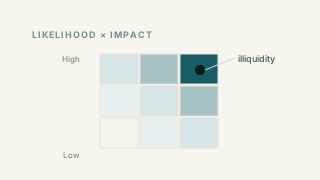
Every investment carries risk, and private market investments are no exception. Private investments come with a distinct set of risks that differ from those of public stocks and bonds. Understanding these risks is one part of evaluating whether a particular offering may be appropriate. This article is educational and is not a recommendation to invest.
Common Risks to Understand
Start investing in private companies today
Create your free account and explore investment opportunities on StartEngine.
1. Illiquidity
What it is: Shares in a private company generally cannot be sold on demand. There is no continuous public trading market, and capital may be tied up indefinitely.
Why it matters: If cash is needed for an emergency or another purpose, a sale may not be possible. Even where a secondary market exists, eligibility, issuer consent, transfer restrictions, regulatory review, buyer demand, pricing, and execution are all uncertain, and a transaction may never occur.
General considerations: Offering materials typically describe transfer restrictions and any holding period requirements. A secondary sale should not be assumed to be available.
2. Possible Loss of Entire Investment
What it is: Private companies, especially early-stage companies, have a high failure rate. If a company fails, the investment may be worth nothing.
Why it matters: Unlike large public companies, which may decline gradually and provide opportunities to sell, private companies can fail abruptly with no recovery of capital.
General considerations: Investors generally consider only committing amounts they can afford to lose entirely. Offering materials disclose risk factors specific to each company.
3. Information Asymmetry
What it is: Private companies typically provide less information than public companies. Decisions are often made with limited data, and management usually knows more about the business than outside investors.
Why it matters: Limited information makes it harder to assess the state of the business, identify problems early, or evaluate ongoing developments.
General considerations: Investors generally review offering documents in full, including risk factors and financial statements, and may look at independent information about the industry and competitors.
4. Dilution
What it is: When a company raises additional capital by issuing new shares, the ownership percentage of existing shareholders decreases. This is called dilution.
Why it matters: Even if a company grows, multiple future financing rounds can significantly reduce ownership percentages. Terms of later rounds may include preferences or other features that further affect the economics of earlier investments.
General considerations: Offering materials typically disclose capitalization, security class, preferences, and any anti-dilution provisions. Additional rounds may be needed, and their terms are unknown at the time of an earlier investment.
5. Valuation Uncertainty
What it is: Private company valuations are negotiated estimates or reference points set by the issuer, not market-determined prices. They are subjective and can be influenced by negotiating dynamics, assumptions, and market conditions.
Why it matters: A negotiated valuation does not represent a current, fair, or realizable price and does not guarantee that shares could be sold at that price. If a company raises a future round at a lower valuation (a "down round"), the reported value of an earlier investment may decline. Security class, preferences, dilution, fees, and transaction restrictions can all affect economics.
General considerations: Offering materials generally describe how a valuation was determined, along with underlying financials, stage, and the terms of the securities offered.
6. Regulatory and Legal Risk
What it is: Changes in laws, regulations, or regulatory interpretation can affect private investments. Companies may also face lawsuits, intellectual property disputes, or compliance issues that harm the business.
Why it matters: Regulatory changes can alter the landscape for a company's products or services. Legal issues can be expensive and, for smaller companies, can threaten viability.
General considerations: Offering documents typically include risk factors describing the regulatory environment in which a company operates.
7. Market and Economic Risk
What it is: Broader economic conditions — including recessions, interest rate changes, and market downturns — can affect private companies. Economic stress can reduce customer demand, make follow-on fundraising more difficult, and delay potential exits.
Why it matters: Companies can struggle in a difficult economic environment. If IPO or acquisition activity slows, potential paths to a liquidity event may be delayed or unavailable.
8. Management Risk
What it is: The performance of a private company is heavily dependent on its management team. Poor decisions, loss of key personnel, or mismanagement can materially harm the business.
Why it matters: In early-stage companies, founders and key executives are often difficult to replace. Turnover or strategic missteps can significantly affect outcomes.
General considerations: Offering materials typically disclose management backgrounds. Investor communications, when provided by an issuer, are one source of ongoing information about a company.
9. Fraud Risk
What it is: As in any market, fraud can occur. Companies or promoters may misrepresent financials, traction, or business prospects.
Why it matters: Misrepresentation can contribute to the loss of an entire investment.
General considerations: Filing requirements differ by exemption. For Regulation Crowdfunding offerings, issuers file a Form C and related offering materials with the SEC on EDGAR, which are publicly available. For Regulation A offerings, issuers file an offering statement on Form 1-A that is qualified by the SEC and publicly available. For Regulation D offerings (including Rule 506), issuers generally file only a Form D notice with the SEC; the full offering materials are typically not publicly filed and are provided directly to prospective investors. General investor educational resources are available from the SEC at investor.gov and from FINRA at finra.org. Filing or qualification with the SEC does not mean the SEC has approved the merits of an offering.
Approaches for Evaluating Risk
Investors approach private market risk in different ways depending on their goals, resources, and circumstances. The following are general considerations, not recommendations.
Reviewing the Offering Materials
Each private offering includes disclosures about the company, its securities, its risk factors, and the terms of the investment. Investors generally review these materials in full. Offering-specific eligibility, minimums, and any investor limits are set out in the offering documents and applicable SEC rules.
How Private Investments May Relate to Different Situations
Private investments are illiquid and speculative. Individual investors' circumstances vary widely, and decisions about allocation to any asset class are personal. Qualified financial, legal, or tax professionals can be consulted for personalized guidance.
Potential Liquidity Paths
Most private company investments do not result in a liquidity event, and investors should generally expect to hold their investment indefinitely. Where a liquidity event does occur, potential paths can include an acquisition, an initial public offering, a secondary sale where permitted, or distributions if applicable. None of these outcomes is guaranteed, and the timing, availability, and pricing of any such path are uncertain.
Staying Informed
Where issuers provide investor updates, those updates are one source of information about ongoing developments. General educational resources from the SEC and FINRA also cover private markets.
Conclusion
Private market investing involves significant risks, including illiquidity, dilution, valuation uncertainty, and the possibility of losing an entire investment. Understanding those risks — through offering materials, independent research, and, where appropriate, professional advice — is a central part of any decision.
Important Disclosures
Securities are offered through StartEngine Primary, LLC, a registered broker-dealer and member FINRA/SIPC.
Neither the SEC nor any state securities regulator has approved these securities or passed upon the accuracy or adequacy of any disclosure.
This communication is for educational and informational purposes only and is not an offer to sell or a solicitation of an offer to buy any security.
This content is general educational information and is not investment, legal, or tax advice. Consider consulting qualified financial, legal, or tax professionals about your individual circumstances.
Investments in private companies are speculative, illiquid, and involve a high degree of risk, including the possible loss of your entire investment. There may be no market for the securities and no assurance that a liquidity event will occur.