Investing in Private Companies · GUIDE
How Private Market Investments May Fit Into a Diversified Portfolio
An educational overview of how private market investments are sometimes considered within a broader portfolio, including diversification concepts, illiquidity considerations, and practical questions to think through.
6 min read
Updated July 23rd, 2026
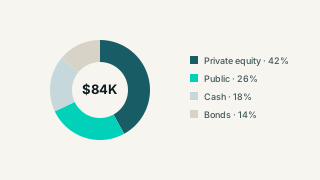
Diversification is a foundational concept in investing: the idea that holding a mix of different assets can reduce the impact of any single investment on an overall portfolio. Many investors are familiar with diversifying across public stocks, bonds, and sometimes real estate. Private market investments are another category that some investors consider. This article discusses, at a general educational level, how private market investments are sometimes described in the context of diversification, and what practical factors to keep in mind. It is not a recommendation to invest in any particular asset class, security, or offering.
What Diversification Means
Start investing in private companies today
Create your free account and explore investment opportunities on StartEngine.
Different investments tend to behave differently under different conditions. Holding a mix of assets that do not move in perfect lockstep can, in some cases, reduce the volatility of a portfolio compared to holding a single asset. Diversification does not eliminate risk and does not guarantee a profit or protect against loss. Concentration risk refers to the potential for outsized losses when a portfolio is heavily exposed to a single investment, issuer, sector, asset class, or other common factor; if that concentrated exposure performs poorly, the impact on the overall portfolio can be significant. Past performance is not indicative of future results.
A Traditional Portfolio
A common individual portfolio might include some mix of:
- U.S. stocks (large-cap, mid-cap, small-cap)
- International stocks
- Bonds (government and corporate)
- Cash and cash equivalents
- Real estate exposure (through REITs or direct ownership)
Private companies are another category of investment that exists outside of public exchanges. Whether and how private market exposure is appropriate for a given individual depends entirely on that individual's circumstances.
How Private Market Investments Are Different
Different Pricing Dynamics
Private company securities are not continuously priced by a public market. Valuations in private offerings are typically negotiated between the issuer and investors and reflect a reference point at a moment in time. They are not the same as a market-determined price and may not reflect the amount an investor could realize in a sale, if a sale is even possible. Company-specific developments, subsequent financings, share class preferences, dilution, fees, and transfer restrictions can all significantly affect the economics of a private investment.
Exposure to Earlier-Stage Companies
Private markets include companies at earlier stages of development than most companies listed on public exchanges. Earlier-stage companies may have limited operating history, limited or no revenue, unproven business models, and a higher likelihood of failure. Any potential for growth is accompanied by a meaningful risk of partial or total loss.
Illiquidity
Private securities are generally illiquid. There may be no market on which to sell them, transfer restrictions may apply, and investors should be prepared to hold their investment indefinitely and to lose the entire amount invested. The "illiquidity premium" is an academic concept debated among researchers, referring to the theoretical idea that investors might, in some cases, be compensated for bearing illiquidity. It remains a subject of ongoing academic debate, and there is no assurance that any additional return will materialize for any particular investment or portfolio.
How Some Institutions Approach Private Markets
Some large institutional investors — such as endowments, pension funds, and sovereign wealth funds — publicly report allocations to private equity, venture capital, private credit, and private real estate. These institutions typically have long investment horizons, dedicated investment staff, access to institutional funds and managers, and the ability to absorb losses that individual investors do not. Material differences between institutional and retail investors — including access to offerings and managers, dedicated diligence resources, fund structures, the scale at which they can diversify, capacity to absorb losses, and time horizon — mean institutional approaches to private markets are not comparable to, and cannot be replicated by, retail private-market investing. Their approach is not a template for any individual investor and should not be interpreted as an endorsement of private investing for retail participants.
Practical Considerations Before Adding Private Investments
Investor Eligibility and Investment Limits
Different types of private offerings have different eligibility rules. Some offerings are limited to accredited investors, while other offerings — such as those made under Regulation Crowdfunding or Regulation A — may be open to non-accredited investors subject to investment limits and other conditions specific to the offering. Investment limits and eligibility criteria can change over time. Investors should review the specific offering materials for any investment they are considering and consult the current guidance published by the SEC at investor.gov.
Liquidity Planning
Because private investments are typically illiquid, an investor's broader financial planning should account for cash needs before any consideration of private investments. Considerations often include:
- Availability of emergency savings in cash or highly liquid form
- Liquid investments sufficient to cover near-term and medium-term financial obligations
- Whether the investor can absorb the loss of the entire amount committed to private investments
Diversification Within Private Investments
Many observers note that private company outcomes are highly variable, and that individual investments can fail. Diversification is sometimes discussed conceptually in the context of private investments — for example, by reference to spreading commitments across companies, industries, stages, or time — but any such approach involves trade-offs and is not a recommendation. Diversification within private markets does not eliminate the risk of loss and does not ensure any particular outcome. Whether any diversification approach is appropriate depends on an individual investor's circumstances. Past performance is not indicative of future results.
Secondary Transactions
Even where a secondary market or transfer mechanism exists for private securities, the ability to sell is uncertain. Transfers may require issuer consent, may be subject to transfer restrictions and regulatory requirements, and depend on the presence of interested buyers and agreed pricing. A transaction may never occur, and any pricing displayed on a secondary platform is a negotiated reference point, not a guarantee of realizable value.
Tax and Legal Considerations
Private investments can have different tax treatment than public securities, including differences in holding periods, characterization of gains and losses, and reporting. Legal terms — including preferences, conversion rights, information rights, and transfer restrictions — can also vary widely. Investors should consult qualified tax and legal professionals about their specific situation before making any investment decision.
Record Keeping
Investors with private holdings may find it helpful to maintain records of:
- Investment dates and amounts
- Company name and security type
- Offering documents and subscription agreements
- Ongoing disclosures received from portfolio companies
- Any distributions, exits, or transfers
Conceptual Note on Holding Multiple Private Investments
Some commentators discuss diversification by reference to holding more than one private company investment. This is a conceptual discussion, not a suggested strategy or recommendation, and does not imply any performance outcome. Outcomes across private investments vary widely, and many private investments result in partial or total loss; individual investments may return nothing or less than the amount invested. Any overall outcome depends on the specific companies, terms, timing, and market conditions involved. This conceptual discussion is not predictive of any actual portfolio's results and should not be read as a projection of performance. There is no assurance that any individual investment or group of investments will produce a positive outcome, and holding a larger number of private investments does not by itself reduce risk or ensure a favorable result. Past performance is not indicative of future results.
Summary
Private market investments are one category among many that investors may consider. They differ from public market investments in pricing dynamics, liquidity, disclosure, and risk profile. Whether they are appropriate for a given investor depends on that investor's financial situation, time horizon, ability to bear loss, and other personal factors. Anyone considering a private offering should carefully review the offering materials, consider consulting qualified professionals, and refer to current guidance published by the SEC at investor.gov.
Important Disclosures
Securities are offered through StartEngine Primary, LLC, a registered broker-dealer and member FINRA/SIPC.
Neither the SEC nor any state securities regulator has approved these securities or passed upon the accuracy or adequacy of any disclosure.
This communication is for educational and informational purposes only and is not an offer to sell or a solicitation of an offer to buy any security.
Investments in private companies are speculative, illiquid, and involve a high degree of risk, including the possible loss of your entire investment. There may be no market for the securities and no assurance that a liquidity event will occur.
This content is general educational information and is not investment, legal, or tax advice. Consider consulting qualified legal, tax, or financial professionals regarding your particular circumstances.