Investing in Private Companies · GUIDE
Reg A+ vs. Reg D vs. Reg CF: Understanding Securities Exemptions
Educational overview of Reg A, Reg D, and Reg CF, including eligibility, offering limits, disclosures, and regulatory differences. Securities are offered through StartEngine Primary, LLC, member FINRA/SIPC.
7 min read
Updated July 23rd, 2026
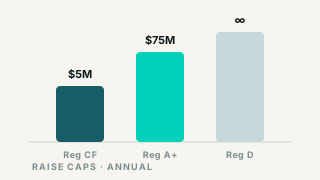
When a private company wants to raise capital by selling securities, it generally must either register the offering with the SEC or rely on an exemption from registration. Many private companies use one of three common exemptions: Regulation A, Regulation D, or Regulation Crowdfunding (Reg CF). Each has different rules about who may invest, how much a company may raise, and what disclosures are required. Understanding these differences can help you interpret offerings you encounter on broker-dealer platforms. The summaries below are general and not exhaustive; always review the specific offering materials and current SEC guidance, since rules and thresholds can change.
The Big Picture
Start investing in private companies today
Create your free account and explore investment opportunities on StartEngine.
All three regulations allow companies to sell securities without conducting a fully registered public offering (such as a traditional IPO). They were designed for different use cases, company sizes, and investor categories. An exemption is not an endorsement of the offering, and qualification, registration, or filing does not mean the SEC or FINRA has approved the merits of any investment.
General maximum raise (subject to change)
- Reg CF: Capped per 12-month period under current SEC rules
- Reg A (Tier 2): Higher cap per 12-month period under current SEC rules
- Reg D (506(b)/506(c)): No dollar cap under the exemption itself
Who may invest
- Reg CF: Generally open to accredited and non-accredited investors, subject to per-investor limits
- Reg A (Tier 2): Generally open to accredited and non-accredited investors, subject to per-investor limits for non-accredited investors
- Reg D 506(b): Accredited investors and up to 35 non-accredited investors who meet the rule's sophistication standard
- Reg D 506(c): Only verified accredited investors
Per-investor investment limits
- Reg CF: Non-accredited investors are subject to limits based on income and net worth under SEC rules
- Reg A (Tier 2): Non-accredited investors are generally limited to a percentage of the greater of annual income or net worth
- Reg D: No per-investor limit under the exemption
SEC filing
- Reg CF: Form C
- Reg A (Tier 2): Form 1-A; SEC qualification required before sales
- Reg D: Form D notice filing (not a substantive review)
Financial statements
- Reg CF: Required; level of review (self-certified, reviewed, or audited) depends on the amount raised
- Reg A (Tier 2): Audited financials required
- Reg D: Varies; no prescribed form for accredited-only offerings, but additional information is required when non-accredited investors participate under 506(b)
General solicitation
- Reg CF: Permitted in limited form through the funding portal or broker-dealer
- Reg A (Tier 2): Permitted
- Reg D 506(c): Permitted (accredited-only, with verification)
- Reg D 506(b): Not permitted
Ongoing reporting
- Reg CF: Annual report on Form C-AR while obligations continue
- Reg A (Tier 2): Semi-annual, annual, and current event reporting
- Reg D: No ongoing SEC reporting required by the exemption itself
Typical channels
- Reg CF: SEC-registered funding portals or broker-dealers
- Reg A (Tier 2): Broker-dealers or funding portals
- Reg D: Directly by issuers, through broker-dealers, or via private placement platforms
Specific dollar caps, per-investor investment limits, and financial statement thresholds referenced in this article are set by SEC rule and may be adjusted from time to time. Refer to the SEC's website and each offering's filings for the current figures.
Regulation Crowdfunding (Reg CF)
Overview
Reg CF was created by Title III of the JOBS Act and became effective in 2016. It was designed to allow startups and small businesses to raise capital from a broader pool of investors through online funding portals and broker-dealers.
Key Features
- Maximum raise: Subject to an SEC-set cap over any rolling 12-month period. Check the SEC's current rule for the applicable dollar figure.
- Investor eligibility: Generally open to both accredited and non-accredited investors, subject to per-investor limits and any offering-specific requirements
- Investment limits: Non-accredited investors are subject to SEC-set limits based on annual income and net worth. Because these thresholds are updated periodically, review the offering page and current SEC guidance for the figures that apply to you.
- Platform requirement: Must be conducted through an SEC-registered funding portal or broker-dealer
- Disclosures: Companies file a Form C, including a business description, risk factors, use of proceeds, officer and director information, and required financial statements
- Ongoing reporting: Companies are generally required to file annual reports while reporting obligations remain in effect
Common Use Cases
- Early-stage companies raising smaller amounts of capital
- Companies raising from customers or communities
- Investors seeking to participate in early-stage offerings at small dollar amounts
Considerations
- The annual raise cap may limit how much a company relies on Reg CF alone
- Per-investor limits apply to non-accredited investors
- Financial disclosures are typically less extensive than those required under Reg A Tier 2
- Reg CF securities are subject to transfer restrictions for a period following issuance and are generally illiquid
Regulation A (Tier 2)
Overview
Regulation A was modernized by Title IV of the JOBS Act and became effective in 2015. Tier 2 permits larger raises with broader investor eligibility and more extensive disclosure obligations than Reg CF.
Important note on the "mini-IPO" label: Reg A Tier 2 is sometimes informally referred to as a "mini-IPO." This label is a colloquialism only and can be misleading. A Reg A Tier 2 offering is not a registered public offering. It does not, by itself, list securities on a national exchange, and it does not create the trading market, liquidity, or public-company reporting profile typically associated with an IPO. Investors should not infer from the "mini-IPO" label that a trading market, resale opportunity, or liquidity event exists or will occur. Any potential for resale depends on multiple factors described below, and no trading market or liquidity event is guaranteed.
Key Features
- Maximum raise: Subject to an SEC-set annual cap for Tier 2. Refer to current SEC rules for the applicable figure.
- Investor eligibility: Generally open to accredited and non-accredited investors, subject to offering-specific requirements
- Investment limits: Non-accredited investors are generally limited to a percentage of the greater of their annual income or net worth (self-certified). Accredited investors are generally not subject to that percentage limit under the exemption.
- SEC qualification: The offering must be reviewed and qualified by the SEC before sales begin. The review process can take a meaningful amount of time, and timing varies by offering. Qualification is not an endorsement of the offering's merits.
- Disclosures: Companies file a Form 1-A, including audited financial statements and detailed business information
- Ongoing reporting: Semi-annual, annual, and current event reports, less extensive than full public company reporting
- Resale: Reg A securities are generally not "restricted securities" under federal law. However, whether an investor can actually sell shares depends on the existence of a market, issuer consent and transfer procedures, blue sky laws, broker-dealer policies, regulatory review, and buyer demand. No secondary market or liquidity event is guaranteed, and a transaction may never occur.
Common Use Cases
- Growth-stage companies raising larger amounts of capital
- Companies that choose a framework with periodic reporting obligations. Use of the Reg A framework does not, by itself, indicate that a company will conduct a future public offering, list on an exchange, or provide any liquidity event, and no such outcome is assured.
- Investors reviewing offerings that include audited financial statements and periodic reports
Considerations
- SEC qualification is more expensive and time-consuming for issuers than Reg CF
- Audited financial statements add issuer cost
- Investments remain speculative and illiquid; the disclosure regime does not eliminate risk
Regulation D
Overview
Regulation D is a long-standing and widely used exemption for private offerings. It predates the JOBS Act and has been a common mechanism for private equity, venture capital, and other private fundraising for decades.
Reg D has two main variants used for capital raising:
- Rule 506(b): No dollar cap under the exemption. General solicitation is not permitted. Up to 35 non-accredited investors who meet a sophistication standard may participate alongside an unlimited number of accredited investors, with additional disclosure requirements when non-accredited investors are included.
- Rule 506(c): No dollar cap under the exemption. General solicitation is permitted, but all purchasers must be verified accredited investors.
Key Features
- Maximum raise: No cap under the exemption
- Investor eligibility: Primarily accredited investors; 506(b) permits limited participation by non-accredited sophisticated investors
- Investment limits: None under the exemption, though issuers may impose their own minimums or maximums
- SEC filing: Form D notice, generally filed within 15 days of the first sale. This is a notice filing, not a substantive SEC review of the offering.
- Disclosures: No specific SEC-prescribed disclosure format for accredited-only offerings. Issuers typically provide a private placement memorandum (PPM) or similar materials. Anti-fraud rules still apply.
- Ongoing reporting: Not required by the exemption, though issuers may have contractual reporting obligations to investors
- Resale: Reg D securities are "restricted securities" and are subject to holding periods and resale limitations. Any resale further depends on issuer consent, transfer restrictions, regulatory review, and buyer demand; a transaction may never occur.
Common Use Cases
- Larger private raises from accredited and institutional investors
- Venture capital and private equity transactions
- Issuers seeking flexibility outside a registered offering
Considerations
- Most Reg D offerings are limited to accredited investors
- There is no SEC review of the offering materials; investors must review disclosures carefully and conduct their own due diligence
- Restricted securities have transfer limitations, and secondary sales are constrained
How These Exemptions Appear on Platforms
Offerings conducted under Reg CF, Reg A, and, in some cases, Reg D (limited to accredited investors) may be found on various broker-dealer platforms and SEC-registered funding portals. This reference is descriptive only and is not a recommendation of any platform or any offering. The mix of offerings available on any particular platform varies over time. In general:
Reg CF offerings are often from earlier-stage companies raising smaller amounts. Investment minimums are typically low, and Form C disclosures are made available for review on the offering page.
Reg A (Tier 2) offerings are more commonly used by later-stage companies raising larger amounts. Reg A Tier 2 offerings must be qualified by the SEC before sales, but qualification is not an endorsement or approval of the offering's merits and does not reflect a substantive SEC assessment of the investment. Any potential for secondary transactions depends on multiple factors, including issuer consent, transfer procedures, regulatory review, market venue rules, buyer demand, and pricing. There is no assurance a secondary transaction will be available at any price, or at all.
Reg D offerings are less common on retail-facing platforms and generally require investors to be verified as accredited (for 506(c)) or to meet the 506(b) requirements.
How to Think About the Differences
No exemption is inherently superior to the others. Each was designed for a different combination of issuer size, investor eligibility, and disclosure. A few general observations:
- Non-accredited investors generally encounter Reg CF and Reg A offerings, since most Reg D offerings require accreditation.
- Accredited investors may see offerings under all three frameworks.
- Investors comparing disclosure levels will find that Reg A Tier 2 requires audited financials and ongoing periodic reports, Reg CF has a defined but generally lighter disclosure framework, and Reg D disclosures are largely determined by the issuer.
Regardless of the exemption, private securities are speculative and illiquid, and outcomes are uncertain.
Conclusion
Reg A, Reg D, and Reg CF are three principal exemption frameworks used for private securities offerings in the United States. Each balances capital-raising flexibility with investor-protection features in a different way. Understanding which exemption governs a given offering can help you interpret the disclosures, understand any per-investor limits that may apply, and evaluate the regulatory context. It does not, however, tell you whether a specific offering is appropriate for your circumstances. Before making any investment decision, read the offering materials in full, review the risk factors, and consider consulting qualified professionals.
Important Disclosures
Securities are offered through StartEngine Primary, LLC, a registered broker-dealer and member FINRA/SIPC.
Neither the SEC nor any state securities regulator has approved these securities or passed upon the accuracy or adequacy of any disclosure.
This communication is for educational and informational purposes only and is not an offer to sell or a solicitation of an offer to buy any security. References to any platform are descriptive and are not a recommendation of that platform or any offering available on it.
This content is general educational information and is not investment, legal, or tax advice. You should consult qualified legal, tax, and financial professionals regarding your specific circumstances.
Investments in private companies are speculative, illiquid, and involve a high degree of risk, including the possible loss of your entire investment. There may be no public market for these securities, transfer may be restricted, and no assurance can be given that any liquidity event will occur.
Specific dollar caps, per-investor investment limits, and financial statement thresholds referenced in this article are set by SEC rule and may be adjusted from time to time. Refer to the SEC's website and each offering's filings for the current figures.
This article is educational and does not solicit any specific offering.