Investing in Private Companies · GUIDE
How to Read a Cap Table
For educational purposes: a cap table records who holds what in a private company, what rights those holdings carry, and how proceeds could be distributed in a future transaction. Here is a general framework for reading one.
7 min read
Updated July 23rd, 2026
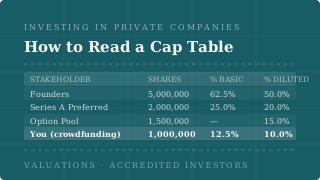
A cap table — short for capitalization table — is a record of equity ownership in a private company. It typically lists shares issued, options granted, and convertible instruments outstanding. When reviewing a private offering, the cap table can help illustrate what a security represents: the class of shares involved, who else holds interests, and how ownership percentages could change in future rounds or a sale. It does not, on its own, indicate whether an investment is suitable for any particular person.
Investors often do not receive a full cap table before investing — particularly in Regulation Crowdfunding offerings with many participants. Offering materials such as the Form C or Form 1-A generally contain summary ownership information rather than the underlying document. Familiarity with what a cap table contains, and what questions it can prompt, may help in interpreting what is disclosed.
What a Cap Table Contains
Start investing in private companies today
Create your free account and explore investment opportunities on StartEngine.
At its simplest, a cap table lists equity stakeholders and the shares they hold. In practice, it is more layered. A cap table for an early-stage company commonly includes several groups:
- Founders — often holding common stock, which may be subject to vesting schedules that release shares over time
- Investors — angels, funds, and crowdfunding participants, who may hold preferred stock (in priced rounds) or unconverted instruments such as SAFEs and convertible notes
- Employee option pool — shares reserved for future grants to employees; the reserved pool is generally counted on a fully diluted basis whether or not options have been issued
- Advisors and service providers — sometimes holding option grants in place of cash compensation
A cap table typically shows two views of ownership: basic (based on currently issued shares) and fully diluted (also counting options, warrants, convertible instruments, and the entire option pool as if converted or exercised). The fully diluted view is often more informative when assessing what a stake represents relative to total potential ownership.
Share Classes and Their Different Rights
Not all shares in a cap table carry the same rights. Private companies often issue multiple classes of stock, and the differences among them can matter as much as the raw ownership percentage.
Common stock is what founders and employees typically hold. It generally carries voting rights and participates in any upside on a sale, but it sits at the bottom of the liquidation stack. In a sale or wind-down, common shareholders are generally paid only after preferred claims are satisfied.
Preferred stock is often issued to institutional investors in priced rounds. It commonly carries a liquidation preference — for example, 1x the amount invested — meaning preferred holders may be entitled to receive that amount before common holders receive proceeds in a sale or dissolution. Some preferred stock is participating, meaning after recovering the preference, those holders may also share in remaining proceeds alongside common. Non-participating preferred generally converts to common to share in upside. Which structure applies varies by company and by round.
Multiple preferred series often stack in reverse chronological order in a liquidation, though the exact order depends on the terms of each series. Series B holders may be paid before Series A holders, who may be paid before Seed holders, who may be paid before common. In a company that has raised several rounds, this waterfall can result in common shareholders and employees receiving less than a headline acquisition price might suggest.
Crowdfunding investors — whether through Regulation Crowdfunding or Regulation A+ — may receive common stock, non-voting classes, or securities that convert into common. The specific security offered and its position in the liquidation stack are described in the offering materials.
How Dilution Works
Dilution occurs when a company issues new shares — for a funding round, to expand the option pool, or to honor SAFEs and convertible notes at conversion. Each newly issued share reduces every existing shareholder's percentage of the total, even though the absolute share count of existing holders does not change.
The following is a hypothetical illustration for educational purposes only; it does not reflect any specific company, offering, or transaction and is not a prediction of any outcome. Assume an investor holds 10,000 shares in a company with 1,000,000 shares outstanding — a 1% stake. If the company issues 250,000 new shares, there are then 1,250,000 shares outstanding. The 10,000 shares now represent 0.8%. The share count has not changed; the relative ownership has.
Dilution is not automatically negative or positive. A new round at a higher negotiated valuation may mean a smaller percentage corresponds to a higher negotiated per-share estimate, while a round at a flat or lower valuation may reduce both the percentage and the negotiated per-share amount. Negotiated per-share amounts referenced in offering materials are not current, fair, or realizable market values. Whether any such change is realizable depends on the terms of each transaction and on future events that cannot be predicted.
Some investors focus on unanticipated dilution — for example, down rounds, large option pool expansions before a raise, or conversion of a stack of SAFEs and notes into equity on terms that were not fully visible at the time of the original investment. Offering documents describe these instruments and are the primary source for evaluating them.
The Liquidation Waterfall
The liquidation waterfall is the order in which proceeds from a sale or dissolution are distributed. It is determined by the combination of share classes, liquidation preferences, and participation rights described in the company's charter and financing documents. The waterfall can produce results that differ from what an ownership percentage alone might suggest.
The following is a simplified, hypothetical example for illustrative purposes only; it does not reflect any specific company, offering, or transaction and is not a prediction of any outcome. Assume a company is sold for $10M and its cap table includes:
- Series A preferred: $6M invested, 1x non-participating liquidation preference
- Seed preferred: $2M invested, 1x non-participating liquidation preference
- Common (founders, employees, and any crowdfunding investors holding common): remaining shares
In this illustration, Series A could receive $6M first and Seed $2M next, leaving $2M to be shared among common holders. The gap between a headline sale price and the amount paid to common shareholders can be meaningful. Examples provided are hypothetical and for illustrative purposes only; they do not reflect any specific company, offering, or transaction and are not a prediction of any outcome.
If instead the Series A were participating preferred, Series A could recover its $6M preference and also share in the remaining $4M alongside common, further reducing the common portion. Whether such terms exist in any given company depends on the specific documents governing the securities.
Anti-Dilution Provisions
Anti-dilution provisions can adjust the conversion terms for certain shareholders — typically preferred investors in priced rounds — if the company later raises money at a lower price per share. They effectively provide protected investors with more shares upon conversion to offset a down round.
Two common formulations are broad-based weighted average (which adjusts the conversion price based on the size of the down round relative to the fully diluted capitalization) and full ratchet (which adjusts the conversion price to the new lower price as if the earlier investor had paid that price for all their shares). The specific mechanic and its effects vary by document.
In a priced round, the offering documents will indicate whether a share class carries anti-dilution protection and what type. Investors receiving SAFEs, convertible notes, or common stock generally do not have equivalent protection, though specific instruments should be reviewed on their own terms.
Questions to Consider When the Full Cap Table Is Not Available
In many crowdfunding offerings, investors do not receive a full cap table. The Form C or offering circular typically includes summary ownership information. General questions the disclosed information may raise include:
- What share class is being offered, and where does it sit in the liquidation waterfall?
- What is the fully diluted share count, including options, warrants, and outstanding convertible instruments?
- How large is the option pool, and has it been expanded recently? A pre-raise option pool expansion can dilute existing holders before a new round closes.
- Are there outstanding SAFEs or convertible notes that have not yet converted? If so, at what valuation caps or discounts, and how many shares could they become at conversion?
- What is the aggregate liquidation preference — the total amount of preferred investment that could be returned before common shareholders participate?
- Do any existing investors hold participating preferred, and if so, on what terms?
How This Connects to Valuation
The cap table and the negotiated valuation are related. A valuation in a private financing is a negotiated reference point used to set a price per share; the cap table describes what those shares represent in terms of ownership percentage, rights, and position in a potential waterfall. A negotiated valuation is not a current, fair, or realizable market value, and the same caveat applies to any per-share amount derived from that valuation or otherwise referenced in offering materials. These figures should be considered together with the underlying capital structure disclosed in the offering materials.
This article focuses on the ownership structure beneath the valuation rather than on how private-company valuations themselves are negotiated. Reviewing offering documents in full — including risk factors, financial statements, and the terms of the securities offered — remains the primary source of information about any offering. The SEC provides general educational resources for investors at investor.gov.
A cap table can be viewed as a map of a company's ownership and rights structure at a point in time. Understanding how to read one may help inform the questions an investor asks about the securities being offered.
Important Disclosures
Securities are offered through StartEngine Primary, LLC, a registered broker-dealer and member FINRA/SIPC.
Neither the SEC nor any state securities regulator has approved these securities or passed upon the accuracy or adequacy of any disclosure.
This communication is for educational and informational purposes only and is not an offer to sell or a solicitation of an offer to buy any security.
This content is general educational information and is not investment, legal, or tax advice. Consider consulting qualified legal, tax, or financial professionals about your particular circumstances.
Examples provided are hypothetical and for illustrative purposes only; they do not reflect any specific company, offering, or transaction and are not a prediction of any outcome.
Investments in private companies are speculative, illiquid, and involve a high degree of risk, including the possible loss of your entire investment. There may be no market for the securities and no assurance that a liquidity event will occur.
Start investing in private companies today
Create your free account and explore investment opportunities on StartEngine.
Terms in this article
Important disclosure
All content is for educational purposes only and does not constitute investment advice. All investments involve risk, including loss of principal. Please consult with a qualified financial advisor before making investment decisions.