Investing in Private Companies · GUIDE
Behavioral Pitfalls in Private Market Investing
Common cognitive biases that can affect private market investors, and process habits that may help address them.
10 min read
Updated September 20th, 2026
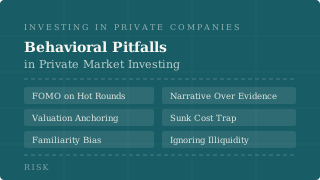
Private markets attract engaged investors. The minimums are often higher, the deals are less visible, and the commitment is longer than almost anything in a public portfolio. Yet the same cognitive traps that appear in public markets show up here too — sometimes in more consequential form, because the positions are illiquid and feedback loops are slow.
This isn't a character critique. These are structural features of how human judgment works under uncertainty, and private markets are structured in ways that can reliably trigger them. Naming them is a first step toward accounting for them. Nothing in this article tells you what to buy, sell, or how to allocate capital — those decisions depend on your own circumstances and the specific offering materials.
FOMO on High-Profile Rounds
Start investing in private companies today
Create your free account and explore investment opportunities on StartEngine.
Few forces in investing are as powerful as the feeling that a deal is filling fast. Private raises are often structured to create exactly this sensation — rolling closes, allocation windows, updates on how much has been raised. The social proof can be real: other people are investing. The scarcity can be real: there is a cap. What isn't necessarily real is the assumption that speed of filling signals quality of deal.
As a general educational observation, and not a comment on any specific offering or issuer, high-profile companies may raise quickly because they have brand recognition rather than because of the underlying business fundamentals. A company already featured in major media and raising at a valuation reflecting that publicity may carry different risk characteristics than a less-known company raising quietly at an earlier stage. The general point is that popularity and pricing in private offerings are set through negotiation and demand dynamics that are not always transparent at the time of the raise; this is educational context and is not an assessment of the valuation of any particular issuer.
One discipline is simple to describe and harder to practice: apply the same diligence framework to a widely publicized deal that you would to an unfamiliar one. If your diligence would take two weeks on an unfamiliar company, consider whether it should take two weeks on the one everyone is talking about.
Overweighting Narrative Over Evidence
Private company pitches are stories. They're designed to be. A founder who can't articulate a vision has a different kind of challenge than a founder whose numbers don't hold up — but in the moment of a pitch, a vivid narrative can crowd out analytical thinking in ways that aren't always obvious.
The general mechanism is discussed in behavioral research: a coherent story can engage emotion and memory, while numbers and data engage slower, more effortful processing. A pitch that opens with a personal story and places unit economics deep in the deck may, whether intentionally or not, lean on this asymmetry.
A possible countermeasure: after reading or watching a pitch, try to write down specific pieces of evidence — not claims, evidence — supporting how the business works. Reported revenue figures, disclosed contracts, verifiable retention data, third-party validation. If evidence is difficult to identify from the offering materials, that itself is useful information.
Anchoring to the Last Valuation
When a company announces it raised a prior round at a given valuation, that number can become a psychological anchor. A new raise at a higher number can feel like validation, momentum, or progress. But valuations in early-stage private companies are negotiated estimates, not market prices. They reflect what a specific set of investors agreed to at one point in time, under one set of assumptions and terms. They are not current, fair, or realizable values, and the security class, preferences, dilution, fees, and transaction terms can significantly change the economics.
A more useful question than whether a new valuation is higher than the last one is whether the new valuation reflects what has actually changed in the business, and how the specific terms of the new security compare. A valuation that rises without meaningful underlying change tells a different story than one accompanied by measurable operational change.
Educational material on how private company valuations are set covers the mechanics in more detail. The behavioral point here is narrower: treat each raise as a fresh evaluation of current reality, not a confirmation of a prior one.
The Sunk Cost Trap
Private investments are illiquid. Selling is generally difficult, and feedback on the outcome of a decision can take years. This combination creates conditions in which sunk cost thinking — evaluating future decisions based on past investment rather than future prospects — can be pronounced.
It shows up most clearly in follow-on decisions. A company you invested in two years ago is raising a bridge round. The business is flat, the original thesis hasn't played out, but not participating may dilute your existing stake. Reasoning along the lines of "I've already put in a certain amount, so I should protect it by putting in more" is sunk cost reasoning. Prior capital is spent regardless of what happens next; the relevant question is how the new investment stands on its own terms, given current information and the specific terms of the follow-on security.
One approach some investors use is to evaluate follow-on opportunities as if they had no prior position — asking whether the company, at this stage, at these terms, would be an investment they would consider on a standalone basis.
Familiarity Bias and Investing in What You Know
The phrase "invest in what you know" can be misleading in the private-market context. It is often repeated, and there is a version of it that reflects a genuine idea: domain familiarity may help an investor form questions about a company's technology, market, or team. But familiarity with a sector is not the same as ability to evaluate an investment, and domain knowledge does not reduce the underlying risk of an investment, including the risk of total loss. Treating familiarity as a substitute for diligence is itself a bias to watch for.
There's another version that can be a trap: investing in companies because the product is personally appealing, without distinguishing between being a good customer and evaluating an investment. Products people enjoy don't always translate into successful investments. A company can have a product you love, a mission you believe in, and a financial structure that carries substantial risk of loss.
Familiarity can also create a false sense of comfort with risk. Investments in your own industry, your own city, or companies you've heard of can feel safer than unfamiliar ones — but feeling safer and being safer are different things. A well-known brand raising at a stretched valuation may still carry significant risk.
Ignoring the Illiquidity Reality
Most private investments should be treated as illiquid for an extended and uncertain period, potentially many years or indefinitely. That's not a worst-case scenario — it's a normal feature of the asset class. Companies take time to mature, and exits through acquisition or IPO, if they occur at all, happen on their own timelines rather than the investor's.
A common behavioral pattern is to underestimate this at the time of investment and to overestimate the ability to access liquidity later. Secondary market platforms for private shares exist, but any transaction depends on issuer consent, transfer restrictions, compliance with applicable securities laws, buyer demand, execution mechanics, and pricing — none of which are guaranteed. A transaction may never occur, and if it does, pricing may differ materially from the last primary round valuation. Counting on secondary liquidity as a fallback is not a reliable plan.
A practical question to ask before investing: could you tolerate losing access to that capital for an indefinite and potentially long period without forcing a secondary sale on unfavorable terms? Your answer is relevant to how you approach the decision.
Overconfidence After Early Outcomes
Private market investing has long feedback cycles, which means early results — in either direction — can be misleading signals about skill. An investor whose first several investments appeared to progress favorably may have applied useful judgment, may have benefited from timing or sector conditions, or both. With a small sample, the distinction is hard to make. Past performance is not indicative of future results.
Early apparent outcomes in particular can produce overconfidence: a sense of having developed a reliable eye for deals. Sometimes that reflects careful analysis; often, it reflects base rates in specific sectors or vintages, or simply variance inherent in a small number of high-risk bets.
One counterweight is process. Investors who write down a thesis before committing, track the specific assumptions they were testing, and review outcomes against those assumptions may build clearer self-assessment over time than those who attribute favorable outcomes to insight and unfavorable ones to bad luck.
What Structured Process Can Look Like
Structure may help address these pitfalls. The following are habits some private investors describe using; they are illustrative rather than prescriptive, and are not a recommendation to adopt any particular practice:
- Writing a short investment thesis before committing — what you believe, what would need to be true for the thesis to hold, and what would contradict it
- Separating the evaluation of the business from the evaluation of the deal terms, including security class, preferences, and dilution mechanics
- Setting a calendar reminder to revisit each investment periodically — not to act, but to record what has changed against what was expected
- Applying a consistent diligence framework (team, product, financials, cap table, legal) regardless of how prominent the company is
- Deciding in advance how you will approach position sizing for any single deal, consistent with your own circumstances, and reviewing whether that approach still fits when a deal feels exceptional
Private investing typically involves long holding periods, illiquidity, and independent evaluation of individual offerings. The features that make it distinctive — the illiquidity, information asymmetry, and long feedback loops — also make it particularly susceptible to the biases that structured process is designed to address. For any specific opportunity, current offering materials, subscription documents, and SEC filings are the authoritative sources for terms, risks, and eligibility.
Important Disclosures
This communication is a retail communication under FINRA Rule 2210 and is intended for a general retail audience for educational and informational purposes only.
Any accompanying SEO metadata, meta title, meta description, open graph tags, and structured data (schema) associated with this article are part of this retail communication and are subject to the same standards under FINRA Rules 2210(b)(1) and 2210(d)(1). Such metadata is intended to be descriptive and non-promotional and should not contain leading, promissory, or performance-based language.
Securities are offered through StartEngine Primary, LLC, a registered broker-dealer and member FINRA/SIPC.
Neither the SEC nor any state securities regulator has approved these securities or passed upon the accuracy or adequacy of any disclosure.
This communication is for educational and informational purposes only and is not an offer to sell or a solicitation of an offer to buy any security.
This content is general educational information and is not investment, legal, or tax advice. Please consult qualified legal, tax, and financial professionals regarding your individual circumstances.
Investments in private companies are speculative, illiquid, and involve a high degree of risk, including the possible loss of your entire investment. There may be no market for the securities and no assurance that a liquidity event will occur.