Selling & Secondary Markets · GUIDE
What Are Secondary Markets for Private Shares?
An overview of how secondary markets for private company shares work, the conditions and restrictions that apply, and the significant uncertainties around pricing and execution.
7 min read
Updated July 23rd, 2026
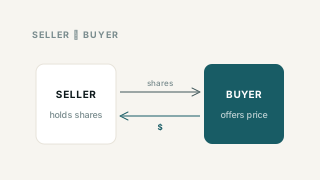
When someone invests in a private company, a common question is how, or whether, they might be able to sell those shares later. Unlike publicly traded stocks, which can generally be sold through a brokerage account during market hours, private shares have historically been difficult to sell before a major event like an IPO or acquisition. In some cases, secondary market mechanisms may offer a possible pathway to a transaction, but eligibility, availability, pricing, and execution are all uncertain. This article provides a general overview of how secondary markets for private shares work and the many conditions that shape whether a sale can actually occur.
This content is general educational information and is not investment, legal, or tax advice. You should consult qualified legal, tax, and financial professionals regarding your particular circumstances.
This article describes secondary market concepts generically as they exist across the industry. It does not describe or promote any specific StartEngine secondary venue or affiliate service. References to StartEngine or any affiliate are descriptive only and are not a recommendation to use any particular platform, venue, or service. The existence of a secondary trading venue does not imply that any particular security is eligible to trade, that liquidity exists, or that any transaction can be completed.
Start investing in private companies today
Create your free account and explore investment opportunities on StartEngine.
Primary vs. Secondary Markets
To understand secondary markets, it helps to start with the distinction between primary and secondary transactions:
- Primary market: When a company sells new securities directly to investors to raise capital. This is what happens during a funding round or an equity crowdfunding offering. The proceeds go to the company.
- Secondary market: When existing shareholders sell their securities to other investors. The company does not issue new shares and does not receive the proceeds — the transaction is between the seller and the buyer.
In public markets, the secondary market is the stock exchange itself. After a company's IPO (the primary offering), subsequent trading of those shares typically occurs on a national securities exchange such as NYSE or Nasdaq.
Private companies do not trade on a national exchange. A range of platforms and mechanisms have developed to facilitate certain secondary transactions in private securities, but these are subject to significant restrictions and are not comparable to public market trading.
Why Secondary Mechanisms Exist
For Shareholders (Potential Sellers)
A shareholder who invested in a private company years earlier may, at some point, want to attempt to sell some or all of those shares. Without a secondary process of some kind, the shareholder would generally need to wait for an exit event such as an acquisition or IPO, which may be years away or may never occur.
Secondary market mechanisms may provide a possible pathway to attempt a sale, but there is no assurance a buyer will be found, that a transaction can be completed, or that any particular price will be achievable.
For Investors (Potential Buyers)
Some investors may seek to purchase shares of private companies through secondary transactions when those companies are not conducting primary offerings. Buyers face the same illiquidity, information limitations, and risk of loss as investors who acquire shares in primary offerings, and may face additional considerations such as limited information about the seller's basis and holding period.
For Companies
Companies generally are not parties to most secondary transactions, but they often play a gatekeeping role through transfer restrictions and consent requirements. Some companies view organized secondary processes as a way to manage shareholder communications and cap table administration in a controlled manner.
How Private Secondary Markets Generally Work
Platform-Based Marketplaces
Some secondary activity occurs through platforms that connect potential sellers of private securities with potential buyers. The description in this section is generic to industry practice and does not describe or promote any specific StartEngine secondary venue or affiliate service. Whether any particular security is eligible to be listed on such a venue, whether the issuer permits trading, whether a counterparty can be found, and whether a transaction can be executed are all uncertain and depend on offering-specific and regulatory conditions. Readers should refer to the current disclosures of any platform they are considering for details about the operating entity, its regulatory status, and applicable terms. This description is provided for informational purposes and is not a recommendation to use any particular venue or platform over any alternative.
Platforms may handle functions such as:
- Facilitating communication between potential buyers and sellers
- Displaying indicative or negotiated prices
- Compliance checks that may be required by applicable regulations
- Processing settlement and share transfer where permitted
Direct (Peer-to-Peer) Transactions
Some secondary transactions occur directly between parties — for example, between an employee and another individual. These transactions typically involve:
- Negotiation of price
- Company consent (most private companies have transfer restrictions)
- Legal documentation
- Compliance with federal and state securities laws
Direct transactions can be complex and often involve attorneys or broker-dealers.
Company-Sponsored Liquidity Programs
Some private companies periodically organize structured processes — sometimes called tender offers or buyback programs — through which certain shareholders may have an opportunity to attempt to sell shares back to the company or to designated investors. These programs are set up and controlled by the issuer, are subject to their own eligibility criteria and terms, and are not always available.
Secondary-Focused Funds
Certain investment firms raise pooled vehicles that seek to purchase private company shares in secondary transactions. Whether such a fund will be interested in any particular security, and at what price, is not predictable.
Typical Steps in a Secondary Transaction
A secondary market transaction in private shares generally involves several steps, each of which may present obstacles:
- Listing or expression of interest: The seller indicates a desire to sell a stated number of shares at a stated price.
- Buyer interest: A prospective buyer indicates willingness to purchase at the stated price or proposes different terms.
- Price negotiation: Buyer and seller attempt to reach agreement on price and quantity.
- Compliance checks: The platform or broker-dealer verifies applicable regulatory requirements that may apply, which can include holding-period considerations and, in some cases, investor status.
- Issuer consent and rights: Most private companies retain rights of first refusal (ROFR), co-sale rights, or other transfer restrictions. The company may need to approve the transfer, exercise its right to purchase, or waive that right. The company can also decline the transfer.
- Transfer execution: If all conditions are satisfied, the shares are transferred and payment is processed.
- Cap table update: The company updates its capitalization records to reflect the change in ownership.
A breakdown at any of these steps can prevent the transaction from occurring. Because this article is general educational information and not personalized advice, any decision to buy or sell in a secondary transaction should involve consultation with a qualified broker-dealer, legal counsel, tax advisor, or other financial professional familiar with your particular circumstances.
Key Considerations
Pricing
Prices in private secondary transactions are negotiated between buyer and seller and are not set by a continuous, transparent market. Reference points that participants sometimes look at include:
- A company's most recent priced financing round, which reflects negotiated terms at that time and may not reflect current conditions. Prior round valuations are historical and are not indicative of current or realizable value.
- Supply and demand on the platform, which may be limited
- Any available information about the company's operations and financial results
- Broader market conditions
A negotiated price is an estimate or reference point, not a determination of fair, current, or realizable value. No price observed on a secondary venue should be relied upon as an indication of the current or future value of any security. Past performance is not indicative of future results. Different share classes have different economic and voting rights, and preferences, dilution, fees, and transaction terms can materially affect economics. Buyers and sellers should review all available offering and issuer documents.
Transfer Restrictions
Most private companies impose contractual restrictions on transfers, which can include:
- Right of first refusal (ROFR): The company or existing investors may have the right to purchase shares on the same terms before a sale to a third party.
- Board or company approval: Transfers may require issuer consent.
- Holding periods: Securities laws and offering terms may require that shares be held for a minimum period before resale.
- Buyer eligibility requirements: Depending on the security and the applicable exemption, a buyer may need to meet specific investor criteria.
Regulatory Framework
The following is general educational information only and is not legal, tax, or investment advice about any specific security, holder, or transaction. Applicable rules depend on the particular offering, exemption, and facts, and readers should consult qualified legal counsel and tax professionals regarding their own circumstances before taking any action.
Secondary transactions in private securities are regulated. The following points are provided as general background and are descriptive of the regulatory framework, not statements about how any rule applies to any particular security or holder:
- Securities issued under Regulation Crowdfunding are generally subject to a one-year resale limitation under Section 4A(e) of the Securities Act and the implementing Regulation Crowdfunding rules (see 17 CFR §227.501), subject to enumerated exceptions set forth in that rule.
- Securities qualified under Regulation A are generally transferable, subject to applicable federal and state requirements.
- Securities sold under Regulation D are generally characterized as "restricted securities" under the federal securities laws and are subject to holding periods and resale conditions, including those set forth in Rule 144.
- Both buyers and sellers are subject to applicable federal and state securities laws. Rules, exemptions, and thresholds are subject to change; readers should consult current SEC guidance, the offering-specific materials, and their own qualified legal counsel regarding their particular situation.
Neither qualification, registration, nor any regulator's review of an offering implies approval of the merits of a security or of a transaction.
Liquidity Is Not Assured
Even where a secondary mechanism exists, there is no assurance that a shareholder will find a buyer, that any offered price will be acceptable, or that a transaction will close. Secondary activity in private securities is generally limited, sporadic, and materially less liquid than trading on a national exchange. Some securities may see little or no activity, and a shareholder may need to continue holding indefinitely.
Development of Private Secondary Markets
Interest in private secondary transactions has been shaped by factors such as:
- Longer private-company lifecycles: Some companies remain private for extended periods, which can increase shareholder interest in exploring liquidity options.
- Broader participation in private offerings: As more individuals invest in private companies through exempt offerings, interest in potential secondary options may have grown.
- Technology: Digital platforms have made it easier to administer compliance and transfer processes.
- Regulatory developments: The SEC and industry participants continue to consider frameworks that shape how secondary transactions in private securities may occur.
Conclusion
Secondary markets for private shares are one part of the broader private market ecosystem. They can provide a possible avenue for shareholders to attempt a sale and for investors to consider acquiring private company shares outside primary offerings, but they operate under significant restrictions.
Private secondary activity is generally limited compared with public market trading. Eligibility, issuer consent, transfer restrictions, applicable regulatory requirements that may apply, buyer demand, pricing, and execution are all uncertain, and a transaction may never occur. Anyone considering a secondary transaction should review the specific offering documents, applicable transfer restrictions, and current regulatory guidance, and should consider consulting a qualified broker-dealer, legal counsel, tax advisor, or other financial professional regarding their particular circumstances. This article is general educational information and is not personalized investment, legal, or tax advice. Past performance is not indicative of future results.
Important Disclosures
This article describes secondary market concepts generically as they exist across the industry. It does not describe or promote any specific StartEngine secondary venue or affiliate service.
Securities are offered through StartEngine Primary, LLC, a registered broker-dealer and member FINRA/SIPC.
Neither the SEC nor any state securities regulator has approved these securities or passed upon the accuracy or adequacy of any disclosure.
This communication is for educational and informational purposes only and is not an offer to sell or a solicitation of an offer to buy any security.
References to StartEngine or any affiliate are descriptive only and are not a recommendation to use any particular platform, venue, or service. The existence of a secondary trading venue does not imply that any particular security is eligible to trade, that liquidity exists, or that any transaction can be completed.
This content is general educational information and is not investment, legal, or tax advice. You should consult qualified legal, tax, and financial professionals regarding your particular circumstances.
Investments in private companies are speculative, illiquid, and involve a high degree of risk, including the possible loss of your entire investment. There may be no market for the securities and no assurance that any liquidity event or secondary transaction will occur.
Past performance is not indicative of future results.