Selling & Secondary Markets · WALKTHROUGH
Understanding the Process of Selling Private Company Shares
An educational overview of the secondary-transfer landscape for private company shares — including shareholder agreement provisions, issuer consent, and other factors that generally affect whether a transaction may occur.
7 min read
Updated July 23rd, 2026
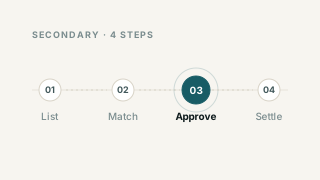
Holders of private company shares — acquired through an equity crowdfunding offering, as an early employee, or as an angel investor — sometimes ask how such shares may be sold. Selling private company shares is materially more complex than selling public stock, and a sale may not be possible. This article describes the general process, common challenges, and pathways that may be available. It is educational information only and is not investment, legal, or tax advice.
Why Selling Private Shares Is Different
Start investing in private companies today
Create your free account and explore investment opportunities on StartEngine.
Shares of publicly traded companies typically trade on national exchanges with continuous pricing and standardized settlement. Private shares generally do not. There is often no centralized market, no continuously quoted price, and no assurance of a buyer.
Factors that commonly complicate the sale of private shares include:
- No public trading market exists for most private company shares.
- Transfer restrictions in the company's governing documents may limit or prohibit resale.
- Securities regulations may impose holding periods and resale conditions.
- Company consent is typically required for any transfer.
- Locating a buyer depends on demand that may not exist.
Even where a secondary transaction pathway exists, eligibility, issuer consent, transfer restrictions, regulatory review, buyer demand, liquidity, pricing, and execution are all uncertain. A transaction may never occur.
Shareholder and Offering Documents
The documents received at the time of investment are generally the starting point for understanding transfer rights. These commonly include:
- Shareholder agreement or operating agreement
- Subscription agreement
- Certificate of incorporation or bylaws
- Any side letters or supplemental terms
Provisions commonly found in such documents include:
- Transfer restrictions: Whether shares can be transferred, and under what conditions.
- Right of first refusal (ROFR): Whether the company or other shareholders can purchase shares on matched terms before a third-party sale.
- Board approval: Whether a transfer requires company or board consent.
- Tag-along / drag-along rights: Provisions that may affect an individual holder's ability to sell independently.
- Lock-up periods: Contractual periods during which transfers are prohibited.
Attempting to transfer shares in violation of these agreements can create legal issues and may render a transaction void. Questions about specific documents are generally best directed to qualified counsel.
Regulatory Resale Conditions Generally
The descriptions below are illustrative of the general regulatory landscape and are not a determination applicable to any particular holder or security. They are provided for educational context only.
Resale of privately offered securities is subject to federal and state securities-law conditions that vary by exemption and by the specific facts of the holder and the security. General, descriptive frameworks include:
- Regulation Crowdfunding (Reg CF) securities: Securities purchased in a Regulation Crowdfunding offering are generally subject to a one-year holding period, with a limited set of enumerated exceptions specified in SEC rules. Refer to current SEC guidance and consult qualified counsel regarding the specific governing rule and its application.
- Regulation A (Reg A+) securities: Securities issued in a qualified Reg A offering are generally not "restricted securities," though transfer may still be affected by issuer-imposed restrictions, state laws, or platform rules.
- Regulation D (Reg D) securities: These are typically "restricted securities" whose resale is subject to conditions under federal and state securities laws.
These descriptions are general and are not a determination of what any individual holder may do. Rules change over time and specific facts matter. Refer to current SEC guidance and consult qualified legal counsel regarding any specific situation.
How Price Is Typically Established
The following is a descriptive summary of factors that market participants sometimes discuss when referencing private company share prices. It is not guidance on how to value any specific holding, and any pricing determination for a particular security requires qualified professional input.
Private shares do not have a continuously quoted market price. Any price associated with a proposed transaction is a negotiated estimate or reference point, not a current, fair, or realizable value. Reference points sometimes discussed include:
- Last primary round valuation: The price at which the company most recently raised capital. This may not reflect current circumstances and does not indicate what a buyer will pay.
- Company financial performance: Reported revenue, growth, or profitability, to the extent disclosed.
- Comparable transactions: Reported pricing in similar companies, with limited comparability.
- 409A valuations: Independent valuations used for option pricing purposes; these are prepared for a specific regulatory purpose and are not a market price.
- Prior secondary transactions: Historical secondary prices, where available, reflect past conditions and may not indicate current pricing.
Secondary transactions can occur at prices that may differ materially from a company's last primary round valuation, in either direction. Security class, liquidation preferences, dilution from subsequent rounds, fees, transfer restrictions, and the specific terms of a transaction can all affect economics.
Pathways That May Be Available
Secondary Trading Platforms
Some regulated platforms provide a venue where holders of certain private company shares may list them for potential sale. Availability depends on the issuer, the security, applicable law, and platform eligibility rules. Not all shares are eligible on any given platform, and a listing does not guarantee a buyer or a completed transaction.
Potential features:
- Structured process operated by a regulated intermediary
- Compliance, matching, and settlement functions handled by the platform
Common considerations:
- Issuer participation and consent are typically required
- Fees may apply and vary by platform
- Liquidity is uncertain and varies by issuer
- A sale may not occur
Direct Sales
A holder may attempt to identify a buyer independently. Direct sales generally require negotiated documentation, compliance with securities laws, and issuer consent.
Common considerations:
- Identifying a willing and eligible buyer can be difficult
- Compliance with federal and state securities laws is the seller's responsibility
- Legal assistance is often necessary to document the transaction
- Company approval is typically still required
Company-Sponsored Buyback or Tender Offer
Some issuers periodically conduct buybacks or tender offers on terms set by the company. Such programs are not common and are entirely at the issuer's discretion.
Common considerations:
- Availability is limited and issuer-specific
- The offered price is set by the issuer and may differ from a shareholder's view of value
- The number of shares eligible to be sold may be capped or prorated
Broker-Dealers Focused on Private Securities
Certain broker-dealers facilitate transactions in private company shares. Services, fees, and eligibility criteria vary.
Common considerations:
- Commissions and fees may be significant
- Coverage typically focuses on a narrow set of well-known private companies
- Execution and pricing are not guaranteed
Issuer Involvement in a Transfer
Nearly all private company share transfers require some form of issuer involvement. This commonly involves:
- Notification to the company of an intent to sell and proposed terms.
- Right of first refusal: The company (and, in some cases, other shareholders) may elect to purchase the shares on the proposed terms or waive that right.
- Board or company consent for a transfer to the proposed buyer.
- Transfer agent or cap table update reflecting the new holder once the transaction is approved and closed.
The process can take weeks or longer. Issuers may request additional information or decline to approve a transfer. Some issuers are cooperative with secondary transactions; others are not, and there is no guarantee of approval.
Documentation and Closing
If a buyer is identified, terms are agreed, and any required consents are obtained, closing typically involves:
- A stock purchase agreement documenting the transaction terms
- Payment from the buyer to the seller, sometimes facilitated by an escrow arrangement
- Transfer of the shares on the company's books or through the transfer agent
- Updated cap table reflecting the new shareholder
Tax Considerations
A sale of private shares may have federal and state tax consequences, and readers should consult a qualified tax professional about their specific circumstances.
General Observations
- Timelines. The process of attempting to sell private shares often takes months, if it can be completed at all.
- Pricing expectations. Secondary pricing frequently differs from headline valuations and may be materially lower.
- Professional advice. Legal, tax, and financial professionals can help evaluate specific documents and situations.
- Recordkeeping. Offering documents, subscription agreements, and correspondence are commonly retained.
- Issuer communication. Cooperation from the company is often essential to completing a transfer.
Conclusion
Selling private company shares is generally more involved than selling public stock. Regulated secondary platforms and specialized broker-dealers describe additional pathways that may be available, but issuer consent, transfer restrictions, regulatory conditions, buyer demand, and pricing all remain uncertain, and any given transaction may not occur.
Reviewing relevant documents carefully, understanding applicable regulatory conditions, and consulting qualified professionals can help set realistic expectations.
Important Disclosures
Securities are offered through StartEngine Primary, LLC, a registered broker-dealer and member FINRA/SIPC.
Neither the SEC nor any state securities regulator has approved these securities or passed upon the accuracy or adequacy of any disclosure.
This communication is for educational and informational purposes only and is not an offer to sell or a solicitation of an offer to buy any security.
This content is general educational information and is not investment, legal, or tax advice. Consult qualified legal, tax, and financial professionals about your specific circumstances.
Investments in private companies are speculative, illiquid, and involve a high degree of risk, including the possible loss of your entire investment. There is generally no public trading market for these securities, resale is restricted, and there is no assurance that a liquidity event or secondary sale will occur.
Past performance is not indicative of future results.
Start investing in private companies today
Create your free account and explore investment opportunities on StartEngine.
Terms in this article
Important disclosure
All content is for educational purposes only and does not constitute investment advice. All investments involve risk, including loss of principal. Please consult with a qualified financial advisor before making investment decisions.