Selling & Secondary Markets · GUIDE
How to Approach Pricing Private Shares
An educational overview of methods and reference points sometimes used to frame a price for private holdings, including illiquidity considerations, share class differences, and market factors.
7 min read
Updated July 23rd, 2026
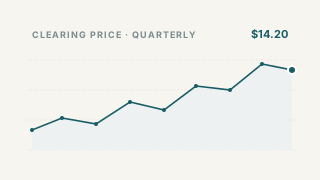
One of the most challenging aspects of attempting to sell private company shares is arriving at a price. Unlike public stocks, where a continuous market quotes prices, private shares do not have real-time price discovery. Whether a holder is exploring a secondary trading venue or a negotiated transaction, understanding common pricing approaches can help frame expectations. This educational overview covers methods, factors, and practical considerations. It is not a valuation, a recommendation, or a promise that any particular price can be obtained or that a sale can occur.
Why Pricing Private Shares Is Difficult
Start investing in private companies today
Create your free account and explore investment opportunities on StartEngine.
Several factors make pricing private shares inherently challenging:
- No public market: There is no exchange providing continuous price discovery.
- Limited transaction data: Few, if any, comparable sales may have occurred.
- Information asymmetry: Sellers often have limited visibility into current financials, cap table changes, or preferences held by other classes.
- Subjectivity: Reasonable parties can disagree significantly about value.
- Illiquidity considerations: Buyers of private shares often expect terms that reflect the illiquid nature of the asset.
- Transfer restrictions and issuer consent: Many private shares are subject to rights of first refusal, transfer restrictions, or issuer approval that can affect whether a sale is possible at all.
Despite these challenges, there are established methods and reference points that participants sometimes use to frame a discussion. Any resulting figure is an estimate, not a guaranteed or realizable value.
Pricing Methods and Reference Points
1. Last Fundraising Round Valuation
A commonly referenced benchmark is the company's most recent primary fundraising round. If a company previously raised capital at a stated post-money valuation, that figure is sometimes used as a starting point for discussion.
How it is sometimes described in the market: As a market-described reference calculation, some participants divide the post-money valuation by fully diluted shares to produce a reference figure and then discuss adjustments from there. This description is not an instruction to perform such a calculation, and any resulting per-share figure is illustrative only, is not a valuation of any reader's specific holding, and is not guidance on what price a reader should pay, accept, or expect for any particular security.
Important caveats:
- The last round price typically reflects preferred stock terms, such as liquidation preferences and anti-dilution provisions, that generally do not apply to common shares.
- Time passes and business conditions may have changed materially since the round.
- Market conditions, subsequent financings, down rounds, or recapitalizations can significantly change the economics for common holders.
- A headline valuation is a negotiated figure between the company and specific investors, not a market price or a realizable value.
2. 409A Valuation
As general educational background, companies issuing stock options generally obtain an independent 409A valuation, which estimates the fair market value of common stock for the company's tax compliance purposes. This section describes how the 409A mechanism works in the abstract and is not guidance on how any reader should treat a 409A figure for the reader's own tax position; readers with tax questions should consult a qualified tax professional. Where available, a 409A figure is sometimes referenced as one third-party data point in a broader discussion.
Caveats:
- 409A figures are prepared for the issuing company's tax compliance, not to establish a transaction price.
- 409A values are commonly lower than the headline valuation from a preferred round because common stock carries fewer rights.
- The valuation may be several months old and may not reflect current conditions.
- Not all shareholders have access to a company's 409A report.
3. Revenue and Earnings Multiples
Some participants attempt to estimate value by applying multiples to a company's financial metrics, such as revenue or EBITDA. Appropriate multiples vary widely by sector, growth profile, capital structure, and market conditions, and change over time.
Caveats:
- This approach requires access to reliable financial data, which many shareholders do not have.
- Multiple selection is highly subjective and cyclical.
- Early-stage companies with limited revenue or negative earnings are difficult to value using multiples.
- An enterprise-level estimate must still be adjusted for share class, dilution, preferences, and illiquidity before reaching a per-share figure.
4. Comparable Transactions
Some participants look at prior secondary market transactions in the same company or in similar companies as a reference.
Caveats:
- Transaction data for private shares is often not publicly available and may be incomplete.
- Each transaction reflects unique circumstances that may not translate to another sale.
- Small sample sizes limit reliability.
5. Discounted Cash Flow (DCF)
A DCF analysis projects future cash flows and discounts them to a present value. This approach is more commonly attempted for later-stage companies with more predictable financials.
Caveats:
- Outputs are highly sensitive to assumptions about growth, margins, and discount rates.
- Generally not practical for early-stage companies.
- Requires financial expertise and reliable projections.
Factors That Can Affect Price
Illiquidity
Buyers of private shares often expect terms that reflect the difficulty of exiting the position. The magnitude of any illiquidity adjustment varies transaction by transaction and depends on factors such as transfer restrictions, the time horizon to any potential liquidity event, transaction size, and buyer demand. No standard discount applies to all situations, and there is no assurance that any resale opportunity will exist.
Share Class and Rights
Not all shares carry the same rights. Preferred shares, often held by institutional investors, typically have rights that common shares do not, such as liquidation preferences, anti-dilution provisions, or specific voting rights. Because of these differences, common shares are commonly valued at a discount to preferred shares. The size of that difference varies by company and capital structure, and any such comparison is illustrative only and not a prediction of price for any specific security.
Company Performance
Changes in revenue, product traction, customer base, cash position, or profitability since the last valuation event may influence how buyers and sellers approach price. Performance can move in either direction and does not guarantee a particular outcome.
Market Conditions
Broader market conditions, interest rates, IPO activity, and sector sentiment can affect how buyers approach private share pricing at any given time.
Supply and Demand
Basic supply and demand dynamics apply. If more shareholders wish to sell than there are interested buyers, prices tend to be pressured lower, and vice versa. There is no assurance that any particular company's shares will attract buyer interest at any given price, or at all.
Time to a Potential Exit
Buyer views may differ based on how visible or distant any potential liquidity event appears. A liquidity event is not guaranteed to occur, and the absence of one may continue indefinitely.
Practical Considerations for Sellers
Factors That May Affect a Transaction
A common source of frustration is anchoring on the headline valuation from a company's most recent preferred round. Common shares generally carry fewer rights than preferred shares, and buyers of private shares typically factor illiquidity into their offers.
Factors a Potential Buyer May Consider
Buyers assessing private shares typically evaluate risk, holding period, share class rights, transfer restrictions, and the possibility of no future liquidity. Considering these factors can help frame realistic price discussions.
Transfer Restrictions
Governing shareholder documents, subscription agreements, bylaws, and any applicable rights of first refusal or issuer consent requirements may affect whether and how a transaction is permitted. A proposed transaction may not be allowed, may require issuer approval, or may be subject to conditions that affect timing and price. Readers can review the current documentation applicable to their specific holdings and, where appropriate, consult a qualified professional.
Negotiation
In private share transactions, initial asking prices are often a starting point. Parties may negotiate terms, timing, and conditions.
Professional Input
For significant holdings or complex situations, some readers choose to consult a qualified financial, legal, or tax professional. This article is general educational information and is not a substitute for professional advice.
Secondary Trading Venues
As a general matter, certain secondary trading venues operated by registered intermediaries may exist under applicable rules. This section is descriptive background about how such venues operate generally and is not a promotion, endorsement, or recommendation of any specific platform or offering. Nothing in this section implies that any such venue is available for any reader's specific security, or that any market or liquidity will exist for any particular security. No specific platform is being promoted here. The description in this section is generic and is not a reference to, or promotion of, any specific StartEngine secondary venue or offering. StartEngine does not commit to establishing, maintaining, or supporting any secondary market for any specific security, and no reader should assume that any such market will be available. Whether a transaction could occur on any such venue depends on multiple factors, including issuer eligibility and consent where required, applicable transfer restrictions, regulatory review, buyer demand, pricing, and execution. There is no assurance that a listing will result in a sale, that any particular price will be obtained, or that a market for the securities will exist.
When considering a listing, participants generally:
- Review any available prior transaction history for the same company's shares.
- Consider the reference points and factors discussed above.
- Monitor interest over time and may adjust listing terms.
- Recognize that secondary transactions can take significant time or may not occur.
Conclusion
Pricing private shares involves research, judgment, and awareness of the limitations of each available reference point. Multiple methods can be used to frame a range, but any resulting figure is an estimate, not a guaranteed or realizable price. Share class, preferences, dilution, transfer restrictions, buyer demand, and market conditions all influence what a transaction may look like, if one occurs at all. Readers should review current offering and platform materials and consider consulting qualified professionals about their specific circumstances.
Important Disclosures
Securities are offered through StartEngine Primary, LLC, a registered broker-dealer and member FINRA/SIPC.
Neither the SEC nor any state securities regulator has approved these securities or passed upon the accuracy or adequacy of any disclosure.
This communication is for educational and informational purposes only and is not an offer to sell or a solicitation of an offer to buy any security.
This content is general educational information and is not investment, legal, or tax advice. You should consult a qualified financial, legal, or tax professional about your specific circumstances.
Investments in private companies are speculative, illiquid, and involve a high degree of risk, including the possible loss of your entire investment. There may be no market for the securities and no assurance that a liquidity event or resale opportunity will occur.
Any valuation methods, reference points, or pricing factors described are illustrative and educational only. They do not constitute a valuation, appraisal, recommendation, or assurance that any particular price is achievable or that any transaction will occur.