Investing in Private Companies · PRACTITIONER GUIDE
How to Evaluate a Private Company Before Investing
An educational framework for researching private company offerings — including team, market, business model, financials, and deal terms — with an emphasis on risk and uncertainty. For educational purposes only; not investment advice or a recommendation.
6 min read
Updated July 23rd, 2026
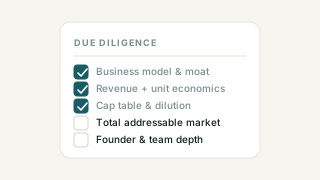
Investing in a private company is different from buying shares of a publicly traded stock. There is generally less public information available, no analyst coverage, and no daily market price. That places a greater burden on the investor to review the materials provided and understand the risks. Whether reviewing an offering on StartEngine or considering any other private investment, this article outlines a general framework for researching private companies. It is educational information only and is not a recommendation to invest in any particular offering.
Why Evaluation Matters in Private Markets
Start investing in private companies today
Create your free account and explore investment opportunities on StartEngine.
Shares of large public companies are followed by many analysts, journalists, and institutions. Prices reflect a wide range of participants and continuously updated information. Private companies typically do not have this level of external scrutiny, and information asymmetry between the company and prospective investors is often significant. Careful review of the offering documents can help narrow that gap, but it cannot eliminate the uncertainty inherent in private investing. Past performance is not indicative of future results.
An Evaluation Framework
1. The Team
For early-stage companies, the team is often a central consideration. Areas to review include:
- Relevant experience: Do the founders and key personnel have background in the industry? Have they built or operated companies before?
- Complementary skills: Does the founding team combine relevant technical, product, and business capabilities?
- Track record: Past results do not guarantee future outcomes, but prior operating experience can be informative.
- Commitment: Are the founders working full-time on the business? Have they contributed their own capital or time?
- Advisors: Does the company disclose advisors, and do their backgrounds appear relevant?
2. The Market Opportunity
Consider the market the company is targeting:
- Market size: How does the company define its addressable market, and is the underlying methodology clear? Be cautious of broad or unsupported market size claims.
- Market dynamics: How does the company describe demand trends, and what evidence supports those descriptions?
- Timing: Is there evidence that customers are ready to adopt the product today?
- Customer problem: Does the offering identify a specific problem and describe why customers would pay to solve it?
3. The Business Model
Understanding how the company earns, or intends to earn, revenue is important:
- Revenue model: Subscriptions, one-time sales, licensing, advertising, or other structures each have different implications.
- Unit economics: If disclosed, review indicators such as customer acquisition cost, lifetime value, and gross margin.
- Scalability: Can the business grow without costs increasing at the same pace?
- Traction: Is the company generating revenue? If so, what is the trend? If not, what milestones must be reached to begin generating revenue?
4. The Product or Service
- Evidence of demand: Look for disclosed metrics such as revenue, user counts, retention, or documented pilots.
- Differentiation: How does the company describe what makes the product different, and how durable does that difference appear?
- Development stage: Is the product commercially available, in beta, or still in development? Earlier stages generally carry greater execution risk.
- Intellectual property: Does the company disclose patents, trademarks, trade secrets, or licensing arrangements?
5. Competitive Landscape
- Direct competitors: Who else addresses the same problem, and how does the company position itself against them?
- Indirect competitors: What alternatives, including doing nothing, might customers choose?
- Barriers to entry: Are there factors that could make it more difficult for new entrants to compete?
- Competitive response: How might larger or better-funded competitors react if the company gains traction?
6. Financial Information
Review the financial information provided in the offering documents. Depending on the offering type, this may include audited or reviewed financial statements, unaudited figures, and forward-looking projections. Forward-looking statements and projections are inherently uncertain, are based on assumptions that may not prove correct, and may not be realized. Areas to consider include:
- Revenue trend: What is the reported revenue history, and how is it changing?
- Burn rate and runway: How much cash is the company using each month, and how long can it operate before needing additional capital? Any burn-rate and runway figures are estimates that depend on assumptions about spending, revenue, and other factors that may change, and actual results may differ.
- Management's stated plan regarding losses or profitability: How does management describe the plan to reduce losses or reach profitability? Any such plan reflects management's view, not a prediction of results, and outcomes are uncertain.
- Prior financing: How much has the company raised previously, from whom, and on what terms?
- Use of proceeds: How does the company describe planned uses of the capital being raised?
7. The Terms of the Investment
The specific terms of the securities being offered can affect the economics of an investment. Review the offering documents carefully for:
- Valuation: The pre-money or post-money valuation shown in an offering is a negotiated reference point set by the company. It is not a market-tested or independently appraised value, does not represent a current, fair, or realizable price, and may not reflect what the securities could later be sold for, if at all.
- Security type: Common stock, preferred stock, convertible notes, SAFEs, revenue-share instruments, and debt instruments each carry different rights, preferences, and risks. Preferences, seniority, and other class-level features can materially change economics.
- Dilution: Future financings, stock option pools, and conversions can reduce an investor's ownership percentage and change the economics of the position.
- Investor rights: Voting rights, information rights, transfer restrictions, and anti-dilution provisions vary by offering and are described in the offering documents.
- Liquidity: Private securities are generally illiquid. Any resale typically depends on issuer consent, transfer restrictions, regulatory review or requirements, buyer demand, available trading venues, pricing, and execution — all of which are uncertain. A resale or liquidity event may never occur.
- Fees and expenses: Review any platform, transaction, or ongoing fees that may apply.
Items That May Warrant Additional Scrutiny
- Aggressive projections: Steep revenue forecasts that are not supported by disclosed assumptions.
- Vague use of proceeds: Broad categories such as "general corporate purposes" without additional detail.
- Limited traction: No customers, revenue, or other evidence of product adoption.
- Insider compensation: Founder or officer compensation that appears disproportionate to the stage of the business.
- Frequent strategic changes: Multiple pivots without a clear rationale.
- Legal or regulatory matters: Disclosed litigation, regulatory inquiries, or intellectual property disputes.
- Incomplete disclosures: Reluctance or inability to answer reasonable investor questions.
Where to Find Information
For offerings conducted under Regulation Crowdfunding and Regulation A, information sources may include:
- The offering page: Business description, team information, financial statements, risk factors, and the terms of the securities offered.
- SEC filings: Form C for Regulation Crowdfunding offerings and Form 1-A for Regulation A offerings are publicly available on the SEC's EDGAR system. A filing does not mean the SEC has approved the securities or passed on the merits of the offering.
- Company communications: Website, product documentation, and public statements.
- Third-party sources: Independent industry reports and news coverage.
- Investor Q&A: Many platforms provide a mechanism to ask questions directly to the issuer.
- SEC investor education: Resources at Investor.gov describe how private offerings work and the risks involved. Investor.gov is an SEC investor-education website; reference to it does not imply SEC endorsement of this content or of any offering. Refer to current SEC guidance and the specific offering materials for any thresholds, limits, or eligibility requirements that may apply to a given offering, as those can change over time.
Building a Consistent Process
A consistent research process can help evaluate opportunities on comparable terms:
- Start with a brief review of the team, market, and traction.
- Read the full offering documents and financial statements before deciding whether to proceed further.
- Compare the offering to others previously researched.
- Educational resources from regulators such as Investor.gov discuss how private investments differ from other asset types. Individual circumstances vary; general educational information is not a substitute for advice from qualified professionals.
- Document the reasoning behind each review so the approach can be refined over time.
Conclusion
Researching a private company generally requires more effort than reviewing a large publicly traded company, but the process is learnable. Focus on what the offering documents actually disclose about the team, the market, the business model, the financials, and the specific terms of the securities.
No amount of research eliminates risk. Private investments are speculative and illiquid, and outcomes are uncertain, including the potential loss of the entire amount invested. Past performance is not indicative of future results. A disciplined approach to reviewing offerings may support more informed decisions, but does not reduce or eliminate the risks of private investing, and cannot guarantee any particular result. Individual circumstances vary; general educational information is not a substitute for advice from qualified professionals.
Important Disclosures
Securities are offered through StartEngine Primary, LLC, a registered broker-dealer and member FINRA/SIPC.
Neither the SEC nor any state securities regulator has approved these securities or passed upon the accuracy or adequacy of any disclosure.
This communication is for educational and informational purposes only and is not an offer to sell or a solicitation of an offer to buy any security.
This content is general educational information and is not investment, legal, or tax advice. Individual circumstances vary; general educational information is not a substitute for advice from qualified professionals.
Investments in private companies are speculative, illiquid, and involve a high degree of risk, including the possible loss of the entire investment. There may be no market for the securities and no assurance that a liquidity event will occur.