Fundamentals · WALKTHROUGH
What Is an Accredited Investor — and What Can It Mean for Access to Private Offerings?
An overview of offering categories where accredited investor eligibility is commonly relevant, and the limits of what eligibility means. Regulatory definitions and thresholds referenced are current as of writing and subject to change.
8 min read
Updated July 23rd, 2026
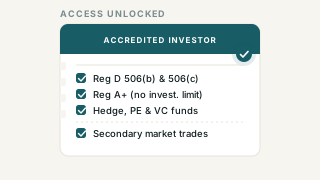
An investor who has confirmed accredited status under current SEC rules has cleared a regulatory threshold that may make them eligible to participate in certain private offerings that are not registered with the SEC. Meeting that threshold is a separate question from whether any particular offering is suitable for a given investor. Regulatory definitions, thresholds, and rules discussed below are current as of writing and are subject to change.
A companion article on accredited vs. non-accredited investors covers the qualification criteria in more detail — income thresholds, net worth tests, and, as of writing, the professional-knowledge pathway added by SEC amendments in 2020. This article picks up from there. It describes categories of offerings that commonly rely on accredited investor eligibility, how those deals are typically structured, and what "access" means and does not mean in practice. Definitions, thresholds, and rules may change; readers should consult current SEC guidance and offering materials for authoritative details.
The Core Distinction: Eligibility for Certain Unregistered Offerings
Start investing in private companies today
Create your free account and explore investment opportunities on StartEngine.
Most investments available to the general public are registered with the SEC. Registration involves significant cost, time, and ongoing disclosure obligations. Many private companies raise capital instead under exemptions from registration, and several of the most commonly used exemptions rely on participation by accredited investors.
Being accredited may make an investor eligible to invest in certain of these exempt offerings. Disclosures in exempt offerings are generally less extensive than in registered public offerings. These investments are typically illiquid, may involve long or indefinite holding periods, and carry a high degree of risk, including the possible loss of the entire amount invested. Eligibility to participate is not an assessment of an offering's quality or suitability.
Rule 506(b) and 506(c): Two Paths Under Regulation D
A common exemption encountered by accredited investors is Regulation D, particularly Rules 506(b) and 506(c). The two differ in ways that affect how offerings can be marketed and how eligibility is confirmed.
Rule 506(b) generally does not permit general solicitation or general advertising of the offering. Companies typically approach investors with whom they have a pre-existing relationship. Up to 35 non-accredited but "sophisticated" investors may participate alongside accredited investors, subject to additional disclosure requirements. Offerings introduced through a personal contact, a syndicate, or a platform an investor already belongs to may be structured under 506(b).
Rule 506(c), adopted following the JOBS Act, permits general solicitation and advertising — including on social media, in emails, and on investment platforms — but limits participation to accredited investors and requires the issuer to take reasonable steps to verify accredited status. Verification may involve submitting tax returns, brokerage statements, or a written confirmation from a licensed professional.
Many private offerings found on equity investment platforms and syndication networks are structured under one of these two rules. Which rule applies affects the type of documentation investors are commonly asked to provide and how the offering may be marketed to them.
Examples of Deal Types Under Regulation D
Regulation D is a legal framework rather than a single investment type. Offerings conducted under it can vary widely in structure and stage. Examples include:
- Angel and seed-stage rounds — early-stage, often pre-revenue companies, sometimes structured as SAFEs or convertible notes
- Priced equity rounds — later-stage companies raising against a negotiated valuation, often structured as preferred equity
- Real estate syndications — pooled investments into commercial or residential properties
- Private funds and special purpose vehicles — venture funds, search funds, and SPVs that aggregate investor capital into a defined strategy
Minimum investment amounts are set by the issuer or fund manager and can vary significantly. The SEC does not set a universal minimum. Valuations in private offerings are negotiated between the issuer and its investors and are not market-clearing prices; the terms of each security — including preferences, conversion mechanics, anti-dilution provisions, transfer restrictions, and any applicable fees — can materially affect economics and outcomes.
Other Contexts Where Accredited Status May Be Relevant
Regulation D is one pathway. Accredited status can also be relevant in several other contexts.
Regulation A+ Tier 2 offerings are open to both accredited and non-accredited investors. Non-accredited investors are generally subject to per-offering investment limits based on income or net worth as described in the current SEC rules. Accredited investors are generally not subject to those particular per-offering limits, though other offering-specific terms may still apply. Investors should consult the offering circular for the specific investment limits and eligibility conditions of any given Reg A+ offering.
Private funds — including many hedge funds, private equity funds, and venture funds — typically require investors to be accredited, and some vehicles also require investors to meet the higher "qualified purchaser" standard defined in the Investment Company Act. Accreditation is generally a minimum condition for these vehicles rather than a complete credential.
Secondary transactions in private company shares are frequently restricted to accredited investors, both by platform policies and by transfer restrictions in the underlying securities. Even when a buyer is accredited, whether a secondary transaction can occur depends on many factors — including issuer consent, right-of-first-refusal and transfer provisions, applicable securities laws and holding periods, regulatory review, buyer demand, negotiated pricing, and execution mechanics. A transaction may take significant time, may occur at a price different from any reference point or prior negotiated valuation, or may not occur at all. There is no assurance of liquidity in private securities, and any prior valuation should be treated as a negotiated reference point rather than a current or realizable price.
Verification: What to Expect
Because Rule 506(c) offerings require verification of accredited status, and because some platforms require verification regardless of offering type, documentation is generally part of the process. Verification methods that issuers or platforms commonly accept include:
- Recent tax returns reflecting income above the applicable threshold
- Brokerage or bank statements reflecting net worth (excluding primary residence) above the applicable threshold
- A written confirmation from a registered broker-dealer, SEC-registered investment adviser, licensed attorney, or CPA
Some platforms maintain verification for a limited period; others require updated documentation for each transaction. The specific requirements and validity periods are set by SEC rules and by each platform or issuer.
What Accredited Status Does Not Do
Eligibility to participate in a private offering is distinct from any judgment about the offering's merits. Private markets include companies at a wide range of stages and quality levels, and valuations are negotiated between the issuer and investors rather than set by a public market.
The accredited investor definition exists to identify investors who are presumed to be able to bear the financial risk of loss associated with unregistered securities. It is not a curation of investment quality. Evaluating the business, team, terms, valuation, dilution risk, and disclosures remains the investor's responsibility. Neither the SEC nor any state securities regulator approves offerings made under Regulation D or vouches for the accuracy or adequacy of any disclosure, and no platform's decision to list an offering should be understood as an endorsement of the investment.
Accredited status may correspond to eligibility for certain regulatory categories of offerings. Careful, independent evaluation of any specific offering — including the offering documents, terms, risks, and the investor's own circumstances — remains a separate step.
Important Disclosures
Regulatory definitions, thresholds, and rules referenced are current as of writing and are subject to change; consult current SEC guidance and offering materials for authoritative details.
Securities are offered through StartEngine Primary, LLC, a registered broker-dealer and member FINRA/SIPC.
Neither the SEC nor any state securities regulator has approved these securities or passed upon the accuracy or adequacy of any disclosure.
This communication is for educational and informational purposes only and is not an offer to sell or a solicitation of an offer to buy any security.
This content is general educational information and is not investment, legal, or tax advice. Consider consulting qualified legal, tax, or financial professionals about your particular circumstances.
Investments in private companies are speculative, illiquid, and involve a high degree of risk, including the possible loss of your entire investment. There may be no market for the securities and no assurance that a liquidity event will occur.