Fundamentals · FRAMEWORK
Accredited vs. Non-Accredited Investors: What You Need to Know
Understand investor classifications, qualification criteria, and what each means for the private market opportunities available to you.
7 min read
Updated June 8th, 2026
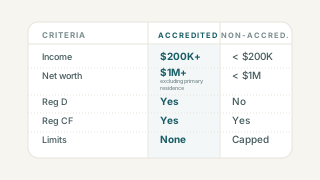
If you've ever explored private market investing, you've likely encountered the terms "accredited investor" and "non-accredited investor." These classifications determine which investment opportunities are available to you and play a central role in how private securities offerings are regulated in the United States. Understanding the distinction is essential for anyone looking to invest in private companies.
What Is an Accredited Investor?
Start investing in private companies today
Create your free account and explore investment opportunities on StartEngine.
An accredited investor is an individual or entity that meets certain financial thresholds established by the SEC. The designation is based on the assumption that individuals with higher income or net worth have the financial sophistication and ability to bear the risks associated with certain types of investments that aren't registered with the SEC.
Qualification Criteria for Individuals
You qualify as an accredited investor if you meet any one of the following:
- Income test: You earned individual income exceeding $200,000 (or $300,000 jointly with a spouse or spousal equivalent) in each of the two most recent years, and you reasonably expect to earn the same in the current year.
- Net worth test: You have an individual net worth, or joint net worth with a spouse or spousal equivalent, exceeding $1 million. This calculation excludes the value of your primary residence.
- Professional certifications: You hold certain professional certifications, designations, or credentials recognized by the SEC. Currently, this includes holders of Series 7, Series 65, and Series 82 licenses.
- Knowledgeable employees: You are a "knowledgeable employee" of a private fund with respect to investments of that fund.
Qualification Criteria for Entities
Entities can also qualify as accredited investors. Common examples include:
- Banks, insurance companies, and registered investment companies
- Employee benefit plans with total assets exceeding $5 million
- Trusts with total assets exceeding $5 million (with some conditions)
- Entities in which all equity owners are accredited investors
- Family offices with at least $5 million in assets under management
What Is a Non-Accredited Investor?
A non-accredited investor is simply anyone who doesn't meet the accredited investor criteria. This includes the vast majority of Americans. Being a non-accredited investor doesn't mean you can't invest in private companies — it means the types of offerings available to you are different, and there may be limits on how much you can invest.
Why Does the Distinction Exist?
The accredited investor concept dates back to Regulation D, adopted by the SEC in 1982. The rationale is investor protection: private securities offerings involve higher risk and provide less regulatory oversight than public offerings. The SEC's position has traditionally been that investors who meet certain wealth thresholds are better positioned to evaluate and absorb these risks.
Critics have argued that wealth doesn't necessarily equal financial sophistication, and that the income and net worth thresholds are somewhat arbitrary. This debate has led to incremental reforms, including the 2020 addition of professional certifications as a qualification path.
What Each Investor Type Can Access
Accredited Investors
Accredited investors have access to the widest range of private investment opportunities:
- Regulation D (Rule 506(b) and 506(c)) offerings: The most common type of private placement, used by startups, private equity funds, hedge funds, and real estate deals. These offerings have no cap on the amount that can be raised.
- Regulation A+ offerings: Open to all investors, so accredited investors can participate here too.
- Regulation CF offerings: Also open to all investors.
- Private equity and venture capital funds: Most traditional funds require accredited investor status.
- Secondary market transactions: Many platforms facilitating sales of private company shares require accredited status.
Non-Accredited Investors
Non-accredited investors have access to a growing but more limited set of opportunities:
- Regulation CF offerings: Companies can raise up to $5 million from all investors, including non-accredited. Individual investment limits apply based on income and net worth.
- Regulation A+ offerings: Companies can raise up to $75 million from all investors. Non-accredited investors may invest up to 10% of the greater of their annual income or net worth per offering.
- Some Regulation D (Rule 506(b)) offerings: Up to 35 non-accredited but "sophisticated" investors may participate, though this is less common in practice.
Platforms like StartEngine offer offerings under both Reg CF and Reg A+, making private market investing accessible to non-accredited investors with minimums as low as $100.
Investment Limits for Non-Accredited Investors
Under Regulation CF, the amount a non-accredited investor can invest across all Reg CF offerings in a 12-month period is capped:
- If both your annual income and net worth are less than $124,000 (as of 2024), you can invest the greater of $2,500 or 5% of the lesser of your annual income or net worth.
- If either your annual income or net worth is $124,000 or more, you can invest up to 10% of the lesser of your annual income or net worth (not to exceed $124,000 total across all Reg CF offerings in a 12-month period).
Under Regulation A+ (Tier 2), non-accredited investors can invest up to 10% of the greater of their annual income or net worth per offering. This limit is self-certified.
Accredited investors face no investment limits under any of these frameworks.
How to Verify Accredited Status
For offerings that require accredited investor status (such as Reg D Rule 506(c) offerings), your accreditation must be verified. Common verification methods include:
- Income verification: Providing tax returns, W-2s, or a letter from a CPA, attorney, or registered investment advisor confirming your income.
- Net worth verification: Providing bank statements, brokerage statements, and other documentation to demonstrate net worth exceeding $1 million (excluding primary residence).
- Third-party verification services: Companies like Verify Investor or VerifyInvestor.com can handle the verification process on behalf of issuers and investors.
For Reg CF and Reg A+ offerings, self-certification of income and net worth is typically sufficient.
The Evolving Landscape
The definition of accredited investor has been a subject of ongoing debate and reform:
- 2020 expansion: The SEC expanded the definition to include individuals with certain professional certifications (Series 7, 65, 82), recognizing that financial sophistication isn't solely determined by wealth.
- Ongoing discussion: There are proposals to further expand the definition based on education, experience, or passing a financial literacy exam. Some advocates argue for eliminating the distinction entirely in favor of robust disclosure requirements.
- Growing access: Regardless of how the definition evolves, Reg CF and Reg A+ have already significantly expanded access for non-accredited investors, and platforms continue to innovate to serve this broader market.
Practical Implications
If You're an Accredited Investor
You have access to the broadest range of investment opportunities. This includes traditional venture capital and private equity investments, as well as platform-based offerings. The key is to use this access wisely — more options don't automatically mean better outcomes. Apply the same rigor of due diligence and diversification that you would to any investment.
If You're a Non-Accredited Investor
You still have meaningful access to private market investments through Reg CF and Reg A+ offerings. Focus on:
- Investing within your limits
- Diversifying across multiple offerings
- Reading offering documents carefully
- Thinking long-term
- Using reputable, regulated platforms
The gap between what accredited and non-accredited investors can access has narrowed considerably, and it continues to narrow as regulations evolve and platforms expand their offerings.
Conclusion
The distinction between accredited and non-accredited investors is a fundamental aspect of private market regulation in the United States. While accredited investors have access to a wider range of opportunities, regulatory reforms have opened significant doors for non-accredited investors through equity crowdfunding and Regulation A+ offerings.
Regardless of your investor classification, the principles of smart investing remain the same: educate yourself, diversify your investments, understand the risks, and invest with a long-term perspective. The most important step is getting started — and today, the barriers to entry are lower than ever.
Start investing in private companies today
Create your free account and explore investment opportunities on StartEngine.
Terms in this article
Important disclosure
All content is for educational purposes only and does not constitute investment advice. All investments involve risk, including loss of principal. Please consult with a qualified financial advisor before making investment decisions.