Advanced Topics · PRACTITIONER GUIDE
Private Company Due Diligence: A Practical Checklist
Seven areas to investigate when researching a private company offering: team, product and market, financials, cap table, use of proceeds, legal and regulatory matters, and traction.
11 min read
Updated July 23rd, 2026
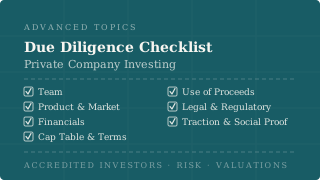
Due diligence is the research you do before committing capital. It will not eliminate risk — private company investing is speculative and can result in the loss of your entire investment — but it can help you understand what you are being offered and what remains unknown. This checklist is descriptive and educational in nature; it is not a recommendation or endorsement of any particular offering, issuer, or security, and it does not suggest that any specific investment is suitable for you. This checklist is a scaffold, not a script, for investors reviewing a private company offering such as a Reg D placement, a Reg CF or Reg A+ raise, or a secondary purchase. Not every question will apply to every deal, and some answers will be unavailable. What you learn from what is missing is often as informative as what you find.
1. Team
Start investing in private companies today
Create your free account and explore investment opportunities on StartEngine.
Many early-stage companies are shaped heavily by their founders. The product will evolve; the people executing may not. Start here.
- What is the founding team's relevant experience — have they worked in this domain before, or is this a first attempt?
- Are the founders full-time? If not, what is the stated timeline or trigger for them to go full-time?
- What does the vesting schedule look like for founders? Unvested founders who leave early can leave large blocks of shares on the cap table or create misaligned incentives.
- Has the team worked together before? What was the outcome?
- Are there gaps in the founding team that the raise is intended to fill? How long has that gap existed?
- Does the team's publicly available professional history match the pitch?
- Have any founders left previously? What are the stated circumstances?
2. Product and Market
A product demonstration alone may not indicate a viable business. Consider whether the product addresses a specific problem for an identifiable customer at a price that the business model can support.
- What specific problem does this product address, and for whom? Is the target customer well-defined or still being discovered?
- Is there evidence of customer demand — paying customers, contracts, or letters of intent — versus interest or sign-ups?
- How is the total addressable market defined, and how was it calculated? Top-down framings ("1% of a $10B market") without bottom-up support warrant scrutiny.
- Who are the direct and indirect competitors, including "do nothing" as the default alternative? How does the company describe its differentiation?
- What stage is the product in — idea, prototype, beta, revenue-generating — and does that match the pitch?
- Is there any intellectual property — patents, proprietary data, exclusive licenses — or is the company relying primarily on execution?
3. Financials
Look at the underlying financial documents disclosed in the offering, not just headline metrics in the pitch.
- What is the current monthly revenue run rate, and what does the trailing 12-month trajectory look like?
- What is the monthly cash burn, and how many months of runway does the company report at its current rate?
- What are the gross margins, and how are they defined? Benchmarks vary widely by business model, so ask how management contextualizes them.
- What is the customer acquisition cost, and how does it compare to the estimated lifetime value? How are those metrics calculated?
- Are revenues recurring or transactional? What does churn or repeat purchase behavior look like?
- Have the financial statements been reviewed or audited by an independent accountant? Requirements vary by exemption and raise size; consult the offering materials and current SEC guidance.
- What assumptions drive the financial projections? Are they grounded in current performance, or do they require step-changes that are not explained? Projections are inherently uncertain and may not be achieved.
4. Cap Table and Deal Terms
Understanding the instrument being offered and where it sits in the ownership structure is a separate exercise from evaluating the business.
- What share class or instrument will you receive — common, preferred, SAFE, or convertible note — and where does it sit in the liquidation waterfall?
- What is the fully diluted share count, including outstanding options, warrants, SAFEs, and convertible notes?
- What is the liquidation preference stack — how much preferred capital must be returned before common shareholders receive proceeds in a sale or liquidation?
- For SAFEs and convertible notes: what is the valuation cap, the discount rate, and what happens if a qualifying priced round never occurs?
- Who are the existing investors, and how much has been invested to date? Are prior lead investors participating in this round?
- What is the minimum and maximum raise for this offering, and what happens if the minimum is not met?
- Are there side letters, special rights, or preferential terms granted to specific investors that are disclosed in the offering documents?
Any valuation shown in an offering is a negotiated reference point between the company and its investors. It is not necessarily a current or realizable market value and does not represent a fair market value determination. Share class, preferences, future dilution, fees, and transfer restrictions can materially change the economics of a position.
5. Use of Proceeds
A raise reflects a hypothesis about what capital can enable. Evaluate whether that hypothesis is coherent and disclosed with specificity.
- What specifically will the raised capital be used for, broken down by category (engineering, sales, marketing, general and administrative)?
- Does the use of proceeds line up with the company's stated next milestone?
- How long is this raise expected to extend runway? What milestone does management expect to reach before raising again?
- What happens if the company raises at the minimum versus the maximum? Is there a materially different operating plan for each scenario?
6. Legal and Regulatory
Legal and regulatory exposure may not surface unless you look for it. The offering documents are the primary source; supplement with public records where appropriate.
- Where is the company incorporated, and is the corporate structure described in the offering materials consistent with the company's stated business and future fundraising plans?
- Are there pending or threatened lawsuits, regulatory investigations, or IP disputes disclosed?
- Does the company operate in a regulated industry (for example, fintech, healthcare, cannabis)? What licenses does it hold, and are compliance requirements addressed?
- Do employees and contractors have IP assignment agreements? Unassigned IP created by early contractors is a common and material issue.
- As a general matter, different securities exemptions are associated with different disclosure filings — for example, Form C is generally associated with Reg CF, an offering circular with Reg A+, and private placement memoranda and Form D filings with Reg D. Specific requirements vary by offering and issuer; consult the offering materials and current SEC guidance for what applies in any particular case.
Filing or qualification of an offering with the SEC does not mean the SEC has approved the offering or endorsed the merits of the securities.
7. Traction and External Signals
External signals from parties other than the issuer are generally harder to fabricate than self-reported metrics, and can provide informational context about what has been observed to date. These signals are informational only; they are not evidence of investment merit, verification of the issuer's claims, or predictors of future outcomes.
- Is there third-party press, analyst coverage, or customer case studies that corroborate claims about the product or growth?
- Are there customer reviews, app store ratings, or public feedback that offer an unfiltered view of product quality?
- Are named investors or advisors actually involved, and can that involvement be confirmed through independent sources?
- Has the company received grants, been accepted to competitive accelerators, or been recognized in its industry? These are informational signals, not predictions of results or indications of investment merit.
How to Use This Checklist
Not every item will be answerable for every deal. A pre-revenue company will not have meaningful unit economics data. A Reg CF raise may not disclose the full cap table. That is common and not automatically disqualifying.
What matters is the pattern of what you can and cannot find. A company that is transparent about its burn but vague about its use of proceeds is communicating something. A founding team with deep domain experience but limited operational background has a different risk profile than one with the inverse. A straightforward legal structure with no traction is different from measurable traction paired with a complex cap table.
Due diligence does not produce a verdict. It produces a clearer picture of the specific opportunity being offered and the risks associated with it. Liquidity is also important to consider: private securities are generally illiquid, and any resale — whether on a secondary platform or otherwise — depends on eligibility, issuer consent, transfer restrictions, regulatory review, buyer demand, pricing, and execution. A resale transaction may never occur.
For additional context, see related educational articles on securities exemptions, common deal structures, and how to evaluate a private company. Always review the offering's official documents and current SEC guidance before making any decision.
Important Disclosures
Securities are offered through StartEngine Primary, LLC, a registered broker-dealer and member FINRA/SIPC.
Neither the SEC nor any state securities regulator has approved these securities or passed upon the accuracy or adequacy of any disclosure.
This communication is for educational and informational purposes only and is not an offer to sell or a solicitation of an offer to buy any security.
This content is general educational information and is not investment, legal, or tax advice. Consider consulting qualified professionals about your circumstances.
Investments in private companies are speculative, illiquid, and involve a high degree of risk, including the possible loss of your entire investment. There may be no market for the securities and no assurance that a liquidity event will occur.
Start investing in private companies today
Create your free account and explore investment opportunities on StartEngine.
Terms in this article
Important disclosure
All content is for educational purposes only and does not constitute investment advice. All investments involve risk, including loss of principal. Please consult with a qualified financial advisor before making investment decisions.