Advanced Topics · GUIDE
Common Deal Structures: SAFEs, Convertible Notes, and Priced Rounds Compared
SAFEs, convertible notes, and priced rounds are different contracts that shape when and how you may become a shareholder.
8 min read
Updated July 23rd, 2026
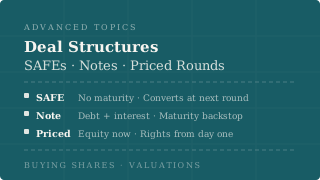
When you invest in a private company, you are not just buying a stake — you are signing a contract that determines when (or whether) you become a shareholder, at what price, and what standing you may have if the company never raises again. Three instruments dominate early-stage private deals: SAFEs, convertible notes, and priced equity rounds. Understanding what you are holding changes how you read everything else in an offering.
The Question Behind the Question
Start investing in private companies today
Create your free account and explore investment opportunities on StartEngine.
Before comparing instruments, one foundational question is worth sitting with: when does your investment become equity — if it ever does?
In a priced round, the answer is generally the moment the round closes. You invest, shares are issued, and your ownership percentage is set at that time (subject to future dilution). With a SAFE or convertible note, you contribute capital now and may receive shares later — at a future triggering event, typically a qualifying priced round. Until that conversion happens, you are an investor under a contract but not yet a shareholder of record.
That distinction is not a technicality. It can affect your rights, your standing in a sale, and what happens if the company winds down before ever raising again.
SAFEs: Simple Agreements for Future Equity
A SAFE is a contract in which you invest a fixed amount today in exchange for the company's promise to issue you shares if and when a qualifying future event occurs — most commonly a priced equity round. The conversion price is generally determined by the SAFE's terms rather than being fixed at signing.
SAFEs generally have no interest rate, no maturity date, and no repayment obligation. If the company never raises a qualifying round, your SAFE may never convert. Depending on the specific document, your recourse in that scenario may be limited, and you could lose the entire amount invested.
Two terms often influence the conversion mechanics:
Valuation cap sets a ceiling on the valuation at which your SAFE converts, regardless of the next round's valuation. A cap is a negotiated reference point, not a statement of the company's current or fair value.
Discount rate lets you convert at a stated percentage below the price paid by the next round's investors. For example, a 20% discount means you would convert at 80% of that round's price per share.
Many SAFEs include one or both. Where both apply, the document usually specifies which governs. SAFEs come in pre-money and post-money forms, which calculate ownership differently and can materially change dilution outcomes. Read the specific SAFE to see which form is used.
Some SAFEs include a most-favored-nation (MFN) clause, which can allow your SAFE to be updated to match more favorable terms offered to later SAFE investors. MFN provisions vary in scope and are not universal — check the document.
Convertible Notes: Debt Designed to Become Equity
A convertible note is a loan structured to convert into equity, typically upon a qualifying future financing. Like other loans, it usually carries an interest rate and a maturity date. Actual rates and terms vary by offering.
Convertible notes can use the same cap and discount mechanics as SAFEs. Key structural differences include:
Maturity date. If no qualifying round occurs before maturity, the company may be obligated to repay principal and accrued interest, or the parties may negotiate an extension or alternative treatment. Whether repayment actually happens depends on the company's ability to pay and the specific terms.
Interest accrual. The amount that converts typically includes accrued interest in addition to the original principal, which can affect the number of shares received on conversion.
Priority in liquidation. Debt generally has a claim on assets ahead of equity holders in a wind-down, but recovery in insolvency is uncertain and, for unsecured noteholders, is frequently minimal or zero. A senior claim in a wind-down does not meaningfully protect principal in most insolvency scenarios. SAFEs, depending on their terms, are often treated similarly to equity or a subordinate contractual right.
Convertible notes preceded SAFEs and remain in use, including in bridge financings between larger priced rounds. Some investors prefer notes for the maturity date feature or comfort with debt-style documentation; others accept SAFEs for their simplicity.
Priced Rounds: Equity at Closing
In a priced round, the company and its investors negotiate a valuation, shares are issued at a per-share price reflecting that valuation, and you become a shareholder of record when the round closes. There is no future conversion event tied to a later financing.
Priced rounds are typically more complex and expensive to execute than SAFEs or notes. They generally require a term sheet, charter amendments to authorize the new share class, and a stock purchase agreement, among other documents. That overhead is one reason many early-stage companies use SAFEs or notes instead. By later stages, priced rounds are more common.
The share class you receive in a priced round — often preferred stock in institutional rounds, sometimes common stock in crowdfunding offerings — carries stated terms that may include, depending on the offering, liquidation preference, anti-dilution provisions, information rights, and pro-rata rights. The presence of such terms does not by itself reduce or mitigate the risk of loss, and their specifics vary widely. Not all of these terms are present in every offering. As covered in the shareholder rights article, the actual governing documents — not summaries — control.
Liquidation preference is one term worth reviewing. Preferred shareholders may be entitled to receive their investment back — and sometimes a multiple of it — before common shareholders share in sale or dissolution proceeds. The specific structure (for example, non-participating or participating, and any multiple) is set in the offering documents. A stated preference does not guarantee recovery, which depends on available proceeds.
How the Three Compare
Ownership set
- SAFE — At conversion, if it occurs
- Convertible Note — At conversion, if it occurs
- Priced Round — At closing
Investor rights
- SAFE — Typically minimal until conversion
- Convertible Note — Typically minimal until conversion
- Priced Round — As specified in the share class terms
Priority in a wind-down
- SAFE — Varies by document; recovery uncertain
- Convertible Note — Debt claim, but recovery not assured and often minimal or zero for unsecured noteholders in insolvency
- Priced Round — Depends on share class and preference terms; recovery not assured
Interest
- SAFE — None
- Convertible Note — Yes, per the note terms
- Priced Round — N/A
Maturity obligation
- SAFE — None
- Convertible Note — Yes, per the note terms
- Priced Round — N/A
Complexity
- SAFE — Generally lower
- Convertible Note — Moderate
- Priced Round — Generally higher
No instrument is inherently better or worse. Each carries different rights, risks, and uncertainties. The appropriate framework depends on the specific offering documents, the company's stage, and the terms you are being asked to accept.
What the Documents Actually Say
The instrument type describes the general shape of the deal. The specific terms describe the economics and risks. Before investing in any of the three, consider locating answers to questions such as:
- Is there a valuation cap, and is it pre-money or post-money?
- Is there a discount rate, and which term applies if both a cap and discount are present?
- For SAFEs and notes: what happens in a sale, dissolution, or other liquidity event before conversion?
- For convertible notes: what happens at maturity if no qualifying round has closed?
- For priced rounds: what are the liquidation preference and anti-dilution terms?
- Is there an MFN clause, a pro-rata right, or transfer restrictions?
For Regulation Crowdfunding and Regulation A offerings, the Form C or offering circular filed with the SEC will describe the instrument and its material terms. Those filings — not campaign pages or marketing materials — govern the securities. Filings with the SEC do not mean the SEC has approved the offering or passed on its merits. The securities exemptions article provides background on the regulatory framework.
The Thing Worth Remembering
Understanding your instrument does not tell you whether a company will succeed or whether the investment will produce any return. It helps you understand what you would own if a conversion or liquidity event occurs, what standing you may have if it does not, and when your ownership percentage would be determined. Investors generally review the offering documents and may consult qualified professionals regarding their specific circumstances.
Important Disclosures
Securities are offered through StartEngine Primary, LLC, a registered broker-dealer and member FINRA/SIPC.
Neither the SEC nor any state securities regulator has approved these securities or passed upon the accuracy or adequacy of any disclosure.
This communication is for educational and informational purposes only and is not an offer to sell or a solicitation of an offer to buy any security.
This content is general educational information and is not investment, legal, or tax advice. Consider consulting qualified professionals about your specific circumstances.
Investments in private companies are speculative, illiquid, and involve a high degree of risk, including the possible loss of your entire investment. There may be no market for the securities and no assurance that a liquidity event will occur.