Fundamentals · GUIDE
Considerations When Evaluating Private Company Investments
An educational overview of how private company investing differs from public markets, including features and important risks and limitations such as illiquidity and possible loss of principal.
6 min read
Updated July 23rd, 2026
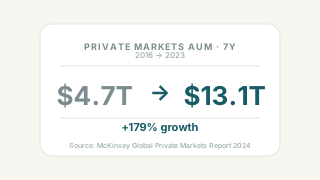
For decades, individual investors primarily accessed capital markets through public stocks and bonds. Some institutional investors — such as pension funds, endowments, and family offices — have also invested in private companies as part of their broader activities. More recently, regulatory frameworks including Regulation Crowdfunding (Reg CF), Regulation A+, and Regulation D have created pathways for a wider range of investors to participate in certain private offerings through platforms like StartEngine. This article provides an educational overview of what private company investing involves, along with the significant risks and limitations that come with it.
Understanding the Private Market
Start investing in private companies today
Create your free account and explore investment opportunities on StartEngine.
Public vs. Private Companies
The universe of private businesses in the United States is far larger than the universe of publicly traded companies. Private companies operate under different disclosure, governance, and liquidity rules than public issuers. Investors evaluating private offerings should recognize that public and private companies are not directly comparable, and that information about private companies is typically more limited.
Company Life Cycles
Companies typically move through different stages — from formation to growth, maturity, and, for some, a liquidity event such as an acquisition or initial public offering. Many companies never reach a liquidity event, and a substantial portion of early-stage businesses fail. The stage of a company can affect the type of information available, the terms of any offering, and the range of possible outcomes for investors, including the loss of the entire investment.
How Institutions Participate
Some institutional investors include private market exposure as part of their broader investment programs. Institutions generally have longer time horizons, dedicated research teams, and access to legal, tax, and structuring resources that individual investors typically do not. The presence of institutional participation in private markets does not indicate that private investments are suitable for any particular individual or that outcomes will be favorable.
Features Investors Sometimes Consider
1. Return Profile
Private company investments — particularly in early- and growth-stage businesses — have a wide range of possible outcomes. Some investments may result in a partial or total loss of capital. Outcomes vary widely and any positive return is uncertain. Past performance is not indicative of future results, and no return should be expected or assumed.
2. Valuation and Relationship to Public Markets
Private investments are structured, valued, and traded differently from public securities. Their reported values, when available, may reflect negotiated estimates rather than market-clearing prices. Private securities are not continuously priced against public market indices, and any observed relationship with public markets is limited by the absence of continuous pricing. This does not mean private investments are safer, and any relationship with public markets can change over time and during periods of economic stress.
3. Exposure to Specific Businesses and Industries
Private offerings can involve companies across many industries, including technology, biotechnology, consumer, financial services, and energy. An investment in a private offering represents a position in that specific company's capital structure, subject to the terms of the offering. Concentrated exposure to a single company or sector can significantly increase risk.
4. Ownership Structure
Founders and management teams often hold equity in private companies. Ownership structures, share classes, voting rights, preferences, and anti-dilution provisions vary widely across offerings and can materially affect the economic outcome for any given class of investors. Investors should review the offering documents to understand what they are buying, what rights they have, and how those rights compare to other classes of securities.
5. Absence of Daily Price Quotations
Because private company securities are not continuously traded, investors typically do not see daily price quotations. The absence of daily pricing is a reporting characteristic, not a measure of risk. Underlying business risk remains, and the eventual price at which a private security might be transferred — if a transfer is possible at all — is uncertain.
Important Risks and Limitations
Illiquidity
Private securities are generally illiquid. Investors should be prepared to hold them indefinitely. Any secondary transaction depends on eligibility, issuer consent, transfer restrictions, applicable regulatory requirements, buyer demand, pricing, and execution — all of which are uncertain. A secondary transaction may never occur, and even if one does, the price may be substantially lower than the amount originally invested.
Limited Information
Private companies are subject to different disclosure requirements than public companies. While issuers conducting regulated offerings must provide certain disclosures, the depth, frequency, and comparability of information are typically less than what is available for public issuers. Investors should carefully review the offering statement, risk factors, financial statements, and other disclosures made available for a specific offering.
Elevated Risk of Loss
Private companies, and early-stage companies in particular, have high rates of failure. Investors may lose some or all of their investment. Dilution from future financings, changes to security terms, additional fees, and preferences held by other classes of investors can further reduce the economic outcome for a given investor.
Long Time Horizons
When outcomes occur at all, they typically take many years. A path to any liquidity event — such as an acquisition, IPO, or repurchase — is not guaranteed, and the timing of any such event, if it occurs at all, is uncertain. Investors should not expect access to their capital in the near term.
Valuation Uncertainty
Valuations for private companies are typically the result of negotiation between the issuer and its investors and reflect assumptions about the business at a point in time. They are reference points, not market prices for publicly traded securities, and should not be treated as current, fair, or realizable values. Security class, preferences, dilution, fees, and transaction terms can meaningfully change the economics of an investment.
Approaching Private Offerings
Review the Offering Materials
Each offering has its own terms, risks, and eligibility requirements. Investors should read the offering circular or Form C, risk factors, financial statements, and subscription agreement carefully. Terms, investor eligibility, and investment limits are offering-specific and can be affected by regulatory requirements and individual investor status. Refer to the current offering materials and to SEC investor education resources for authoritative information.
Use Registered Platforms
Regulated crowdfunding and other exempt offerings are conducted through intermediaries registered with the SEC and FINRA. Registration of an intermediary is not an endorsement of any offering or issuer, and neither the SEC nor any state securities regulator approves the merits of securities offered.
Factors Commonly Described in Investor Education
Regulators and investor-education resources describe factors such as financial situation, investment objectives, time horizon, and tolerance for risk and illiquidity as considerations investors may review with qualified professionals when learning about private investing generally. Private offerings are subject to investor eligibility requirements and are not suitable for all investors. Any decision about a specific offering is an individual matter that many investors discuss with qualified financial, legal, and tax professionals in light of their own circumstances.
Read Beyond Marketing Materials
Company pitches and summaries are marketing communications. The offering documents contain the terms and risk factors that govern an investment. Reviewing those documents — including how the security is structured, what rights it carries, and what could cause the investment to lose value — is an important part of evaluating an offering.
Conclusion
Private company investing differs from public market investing in important ways, including how securities are offered, priced, held, and transferred. It involves significant risks, including illiquidity, limited information, valuation uncertainty, dilution, and the possibility of losing the entire investment. Educational resources and offering-specific documents are the starting point for understanding what a particular private investment involves.
Important Disclosures
Securities are offered through StartEngine Primary, LLC, a registered broker-dealer and member FINRA/SIPC.
Neither the SEC nor any state securities regulator has approved these securities or passed upon the accuracy or adequacy of any disclosure.
This communication is for educational and informational purposes only and is not an offer to sell or a solicitation of an offer to buy any security.
This content is general educational information and is not investment, legal, or tax advice, and is not a recommendation to buy, sell, or hold any security. Consider consulting qualified financial, legal, and tax professionals about your specific circumstances before making any investment decision.
Investments in private companies are speculative, illiquid, and involve a high degree of risk, including the possible loss of your entire investment. There may be no public or secondary market for these securities, and no assurance that any liquidity event will occur. Private offerings are subject to investor eligibility requirements and are not suitable for all investors.
Past performance is not indicative of future results.